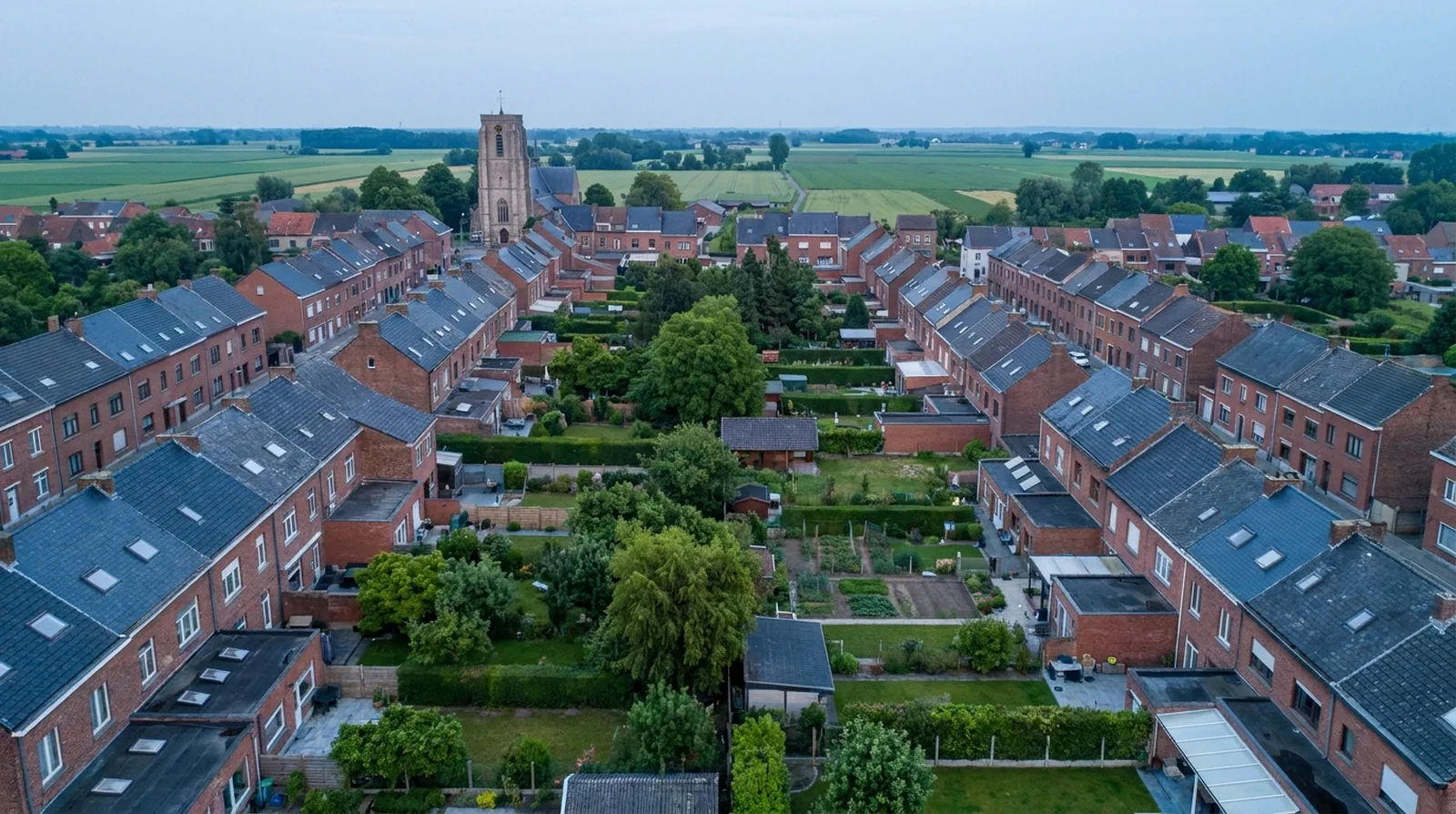
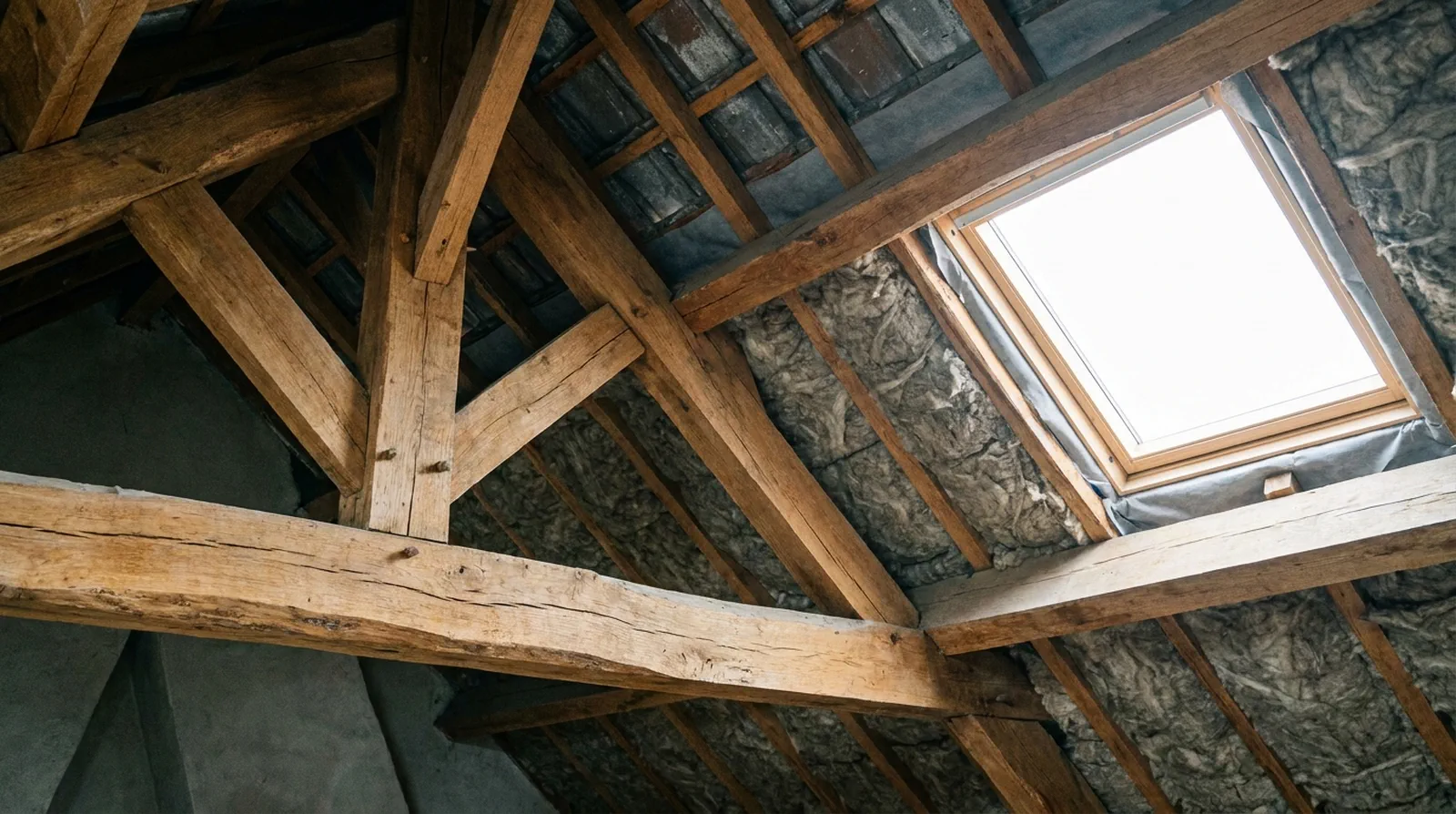
Warm air rises. In a house with an uninsulated roof, a large share of the heat leaves the building through the top, and that happens to be the easiest surface to deal with. Hence the rule any contractor will give you: start with the roof.
Loft floor or slope?
The loft serves no purpose and never will? Insulating the floor is quicker, cheaper and just as effective. The loft stays cold, but that does not matter: the heat stays below. Provided the hatch or the stairwell is dealt with as well — an uninsulated hatch cancels out a good part of the work.
The loft is lived in, or might be one day? Then it is the slope itself that has to be insulated, between the rafters and preferably over them as well. It costs more, but it is the only way to make the space usable. And the right moment is when the roof is being redone anyway: the scaffolding and the strip-out are already paid for.
The vapour barrier is not a detail
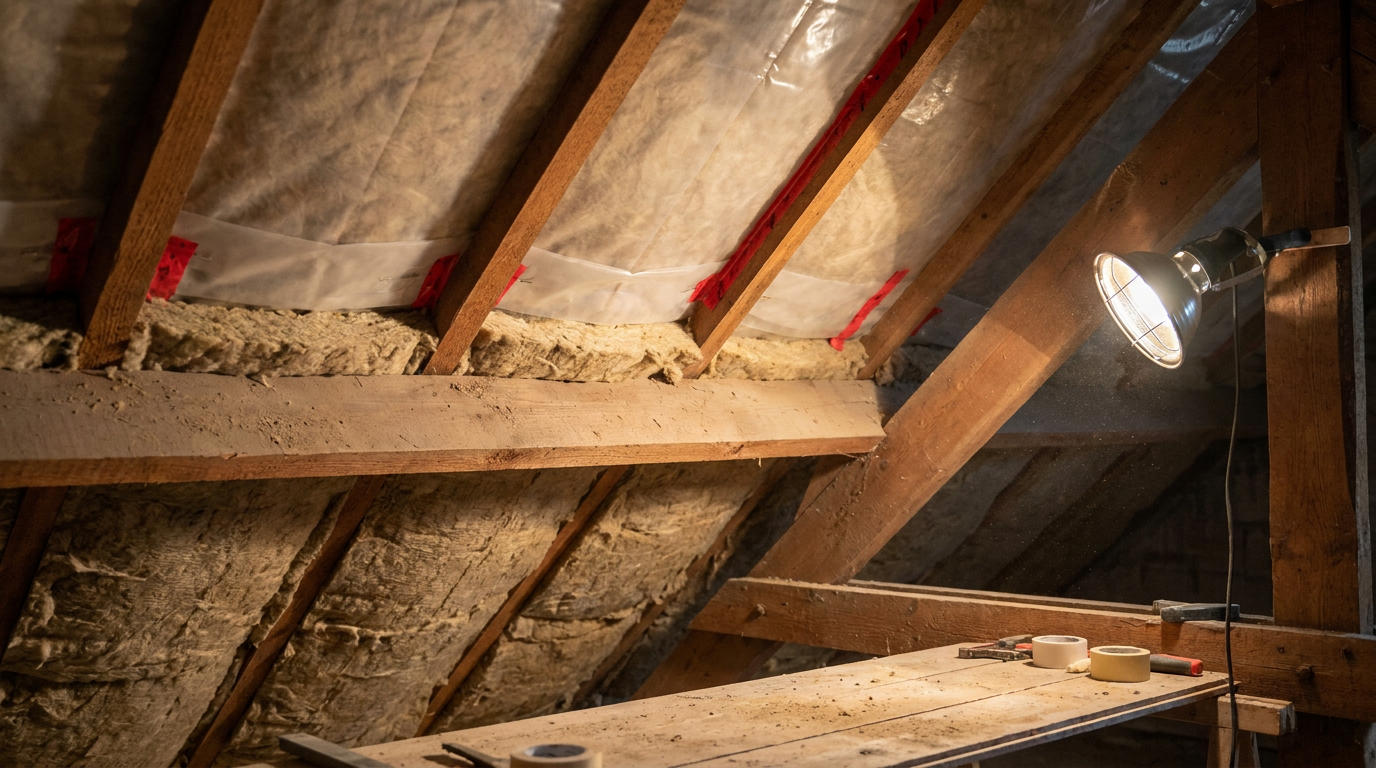
Indoor air contains moisture. With no barrier, that moisture gets into the insulation, cools down inside it and condenses against the cold face. Wet insulation no longer insulates, and the timber around it starts to rot. A vapour barrier on the warm side stops that moisture — provided it is continuous.
Continuous means: laps taped, junctions with walls and beams sealed, and every penetration for a cable or a downlight made good. A single untreated penetration is enough to create a localised damp problem. We see it almost every week on roofs insulated “properly” some fifteen years ago.
Just as important: the air gap between the insulation and the roofing underlay. It has to stay clear and be able to ventilate at the bottom as well as at the top. Insulation pushed right up against the underlay closes that gap. It is one of the most frequent mistakes we come across around Zaventem, where a great many roofs have had acoustic weight added to them after the event.
From the inside or from the outside
Insulating from the inside does not require opening up the roof: the occupants stay put, the weather plays no part and the work is confined to the loft. Drawback: you lose headroom, and every rafter forms a thermal bridge unless a second layer is added underneath.
Insulating from the outside — sarking — means opening up the roof and laying the insulation in continuous boards over the rafters. No thermal bridges, no space lost, and the roof structure stays visible if you want it to. It is the best solution, but it only makes sense if the covering is being renewed anyway.
Grants: what you have to check yourself
Both the Flemish Region and the Brussels-Capital Region provide support for roof insulation — in Flanders through Mijn VerbouwPremie, in Brussels through the regional renovation grant scheme. The amounts, the conditions and the application deadlines are, however, revised regularly.
So we deliberately quote no figures on this page: anything we put here would be out of date within a year. Check the conditions in force with your Region before ordering the work: in most schemes the application is made after the invoice but within a set period, and there are sometimes requirements on the R-value or on the contractor.
What we do do, on the other hand: supply the technical data such an application needs — type of insulation, thickness, R-value, and an invoice that states this information. Ask for it in advance and we set it out on the document straight away.
This service in your municipality
- roof insulation in Tienen
- roof insulation in Grimbergen
- roof insulation in Vilvoorde
- roof insulation in Zaventem
- roof insulation in Machelen
- roof insulation in Brussels
- roof insulation in Schaerbeek
- roof insulation in Anderlecht
- roof insulation in Ixelles
- roof insulation in Uccle
- roof insulation in Molenbeek-Saint-Jean
- roof insulation in Jette