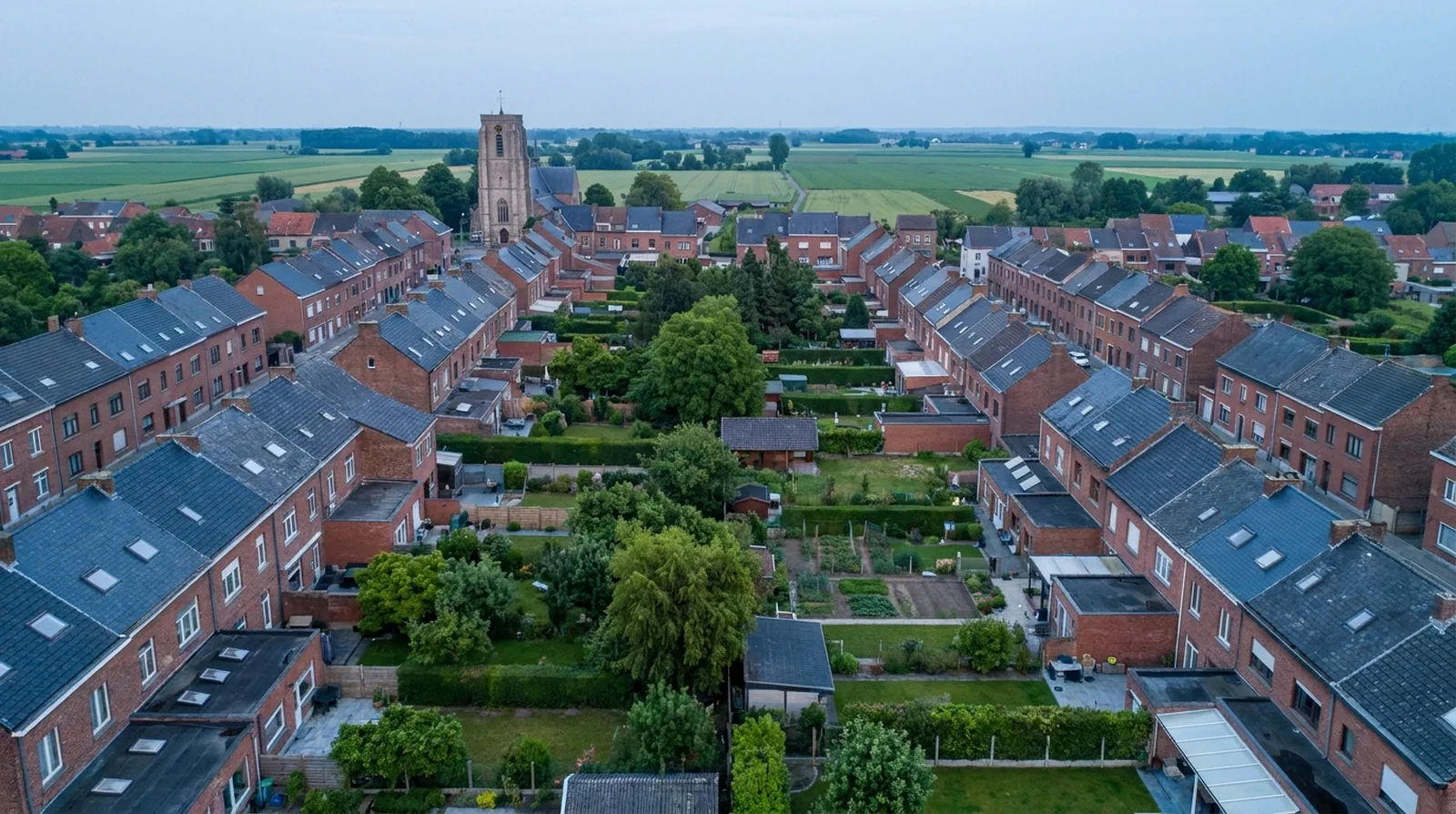
Around Tienen, Landen and Asse, almost every old shed, cowshed or garage still carries corrugated fibre cement sheets. The question is rarely whether there is asbestos — before 2001 there almost always is — but what condition the sheet is in, and what that means for your timetable.
How to recognise it without guessing
Fibre cement sheets laid before 2001 as a rule contain asbestos fibres; those laid after do not. The year the building went up tells you very little — the roof may well have been redone since. What does give you something to go on is the marking on the underside. After the changeover, manufacturers systematically applied “NT” (new technology) or an equivalent wording.
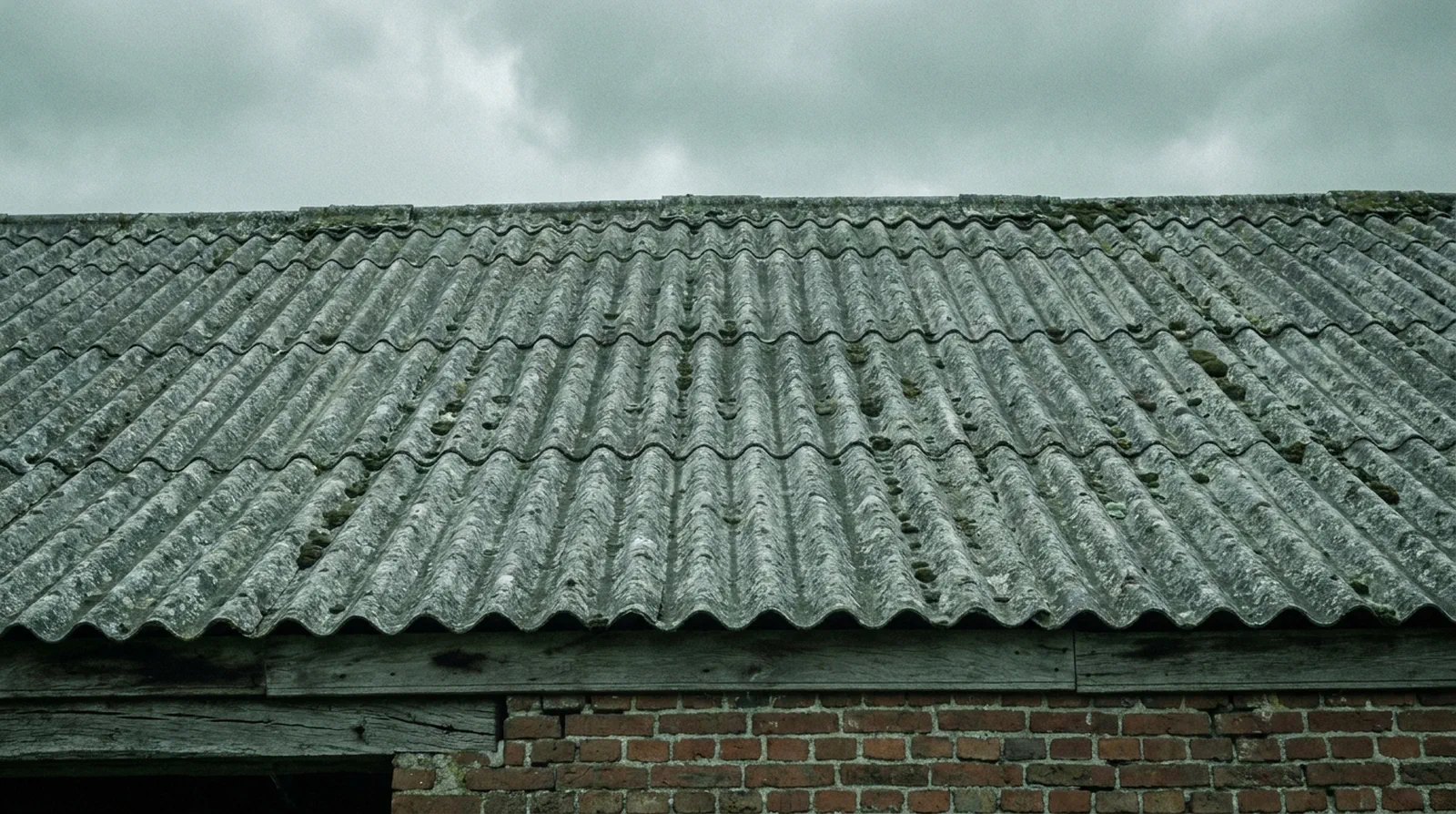
Second clue: the surface. Asbestos sheets generally become coarser and more fibrous as they age; the more recent ones stay smoother. But that judgement is never conclusive. If in doubt, laboratory analysis of a small sample is the only certainty, and that sample has to be taken by someone who knows how to do it without creating dust.
Deterioration is the real risk
As long as the sheet is intact and nobody saws, drills or brushes it, the fibres stay bound in the cement. The danger appears when that bond disappears. Thirty years of rain, frost and UV wash away the cement skin; what is left is a rough surface where the fibre comes to the top and leaves with the rainwater into the gutter and onto the ground.
That is why, on a visit, we look at the surface first and only then at everything else. A sheet that is still smooth, with its corrugations properly aligned, can last a few more years without trouble. A sheet whose fibre has been colonised by moss and whose edge is crumbling is another matter — and it only carries on.
Selling: the asbestos certificate (asbestattest)
In Flanders, selling a building put up before 2001 requires an asbestos certificate, the asbestattest. The document is drawn up by a certified expert after an inventory on site; it sets out which asbestos-containing materials are present and in what condition. We do not issue that certificate — it is a separate, regulated role — but we work with it every day.
In practice that means a roof of deteriorated sheets no longer goes unnoticed in a sale. It is written down, the buyer reads it, and it weighs on the negotiation. Many owners therefore choose to have the sheets removed before putting the property on the market. The rules and the deadlines change regularly: check the conditions in force with OVAM before planning anything.
How a proper removal is carried out
Bonded asbestos cement sheets are taken down one by one, from the top downwards, without sawing or breaking. The hooks are cut through or unscrewed, not torn out. Every sheet goes straight into a closed big bag or double sheeting — not onto a pile to be sorted later.
Transport is to an approved facility, and you receive a document for it. Keep it. It is the only proof that the asbestos was disposed of properly, and it is asked for when the building is sold or by your insurer. We hand it over as a matter of course, without you having to ask for it.
The new covering follows immediately after the strip-out: profiled steel sheet for a shed or a cowshed, asbestos-free fibre cement where the appearance has to match the rest of the yard, or a conventional tiled covering where the structure allows it.
What determines the quotation
Not the square metres alone. Three things count for more: the condition of the sheets (a friable sheet takes more precautions and more time), the access (can a cherry picker be set up or does everything have to go via a scaffold), and the volume of waste to be taken away. That last item is often the heaviest, and it is the one nobody allows for.
That is why we do not give a figure over the phone. We go up and look, we measure, and we price item by item — so that you can see what the strip-out costs, what the disposal costs and what the new covering costs. Those three should not sit on a single line.
This service in your municipality
- asbestos removal in Tienen
- asbestos removal in Grimbergen
- asbestos removal in Vilvoorde
- asbestos removal in Zaventem
- asbestos removal in Machelen
- asbestos removal in Brussels
- asbestos removal in Schaerbeek
- asbestos removal in Anderlecht
- asbestos removal in Ixelles
- asbestos removal in Uccle
- asbestos removal in Molenbeek-Saint-Jean
- asbestos removal in Jette