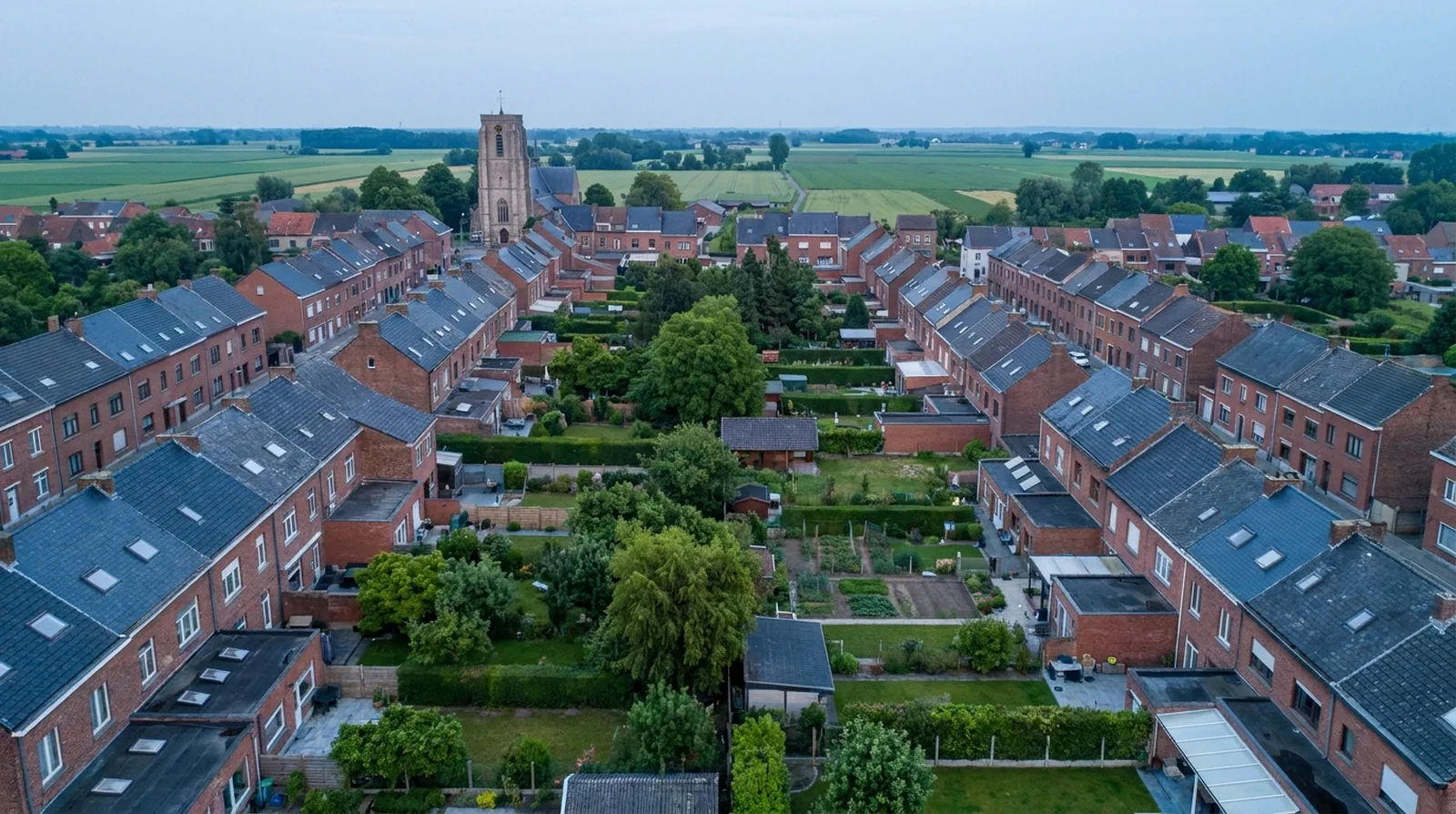
Almost every Belgian terraced house has a rear extension with a flat roof: kitchen, bathroom, garage or veranda. It is the part of the roof nobody ever climbs onto, and therefore the one whose problem only shows up as water in the kitchen unit.
The four suspect zones
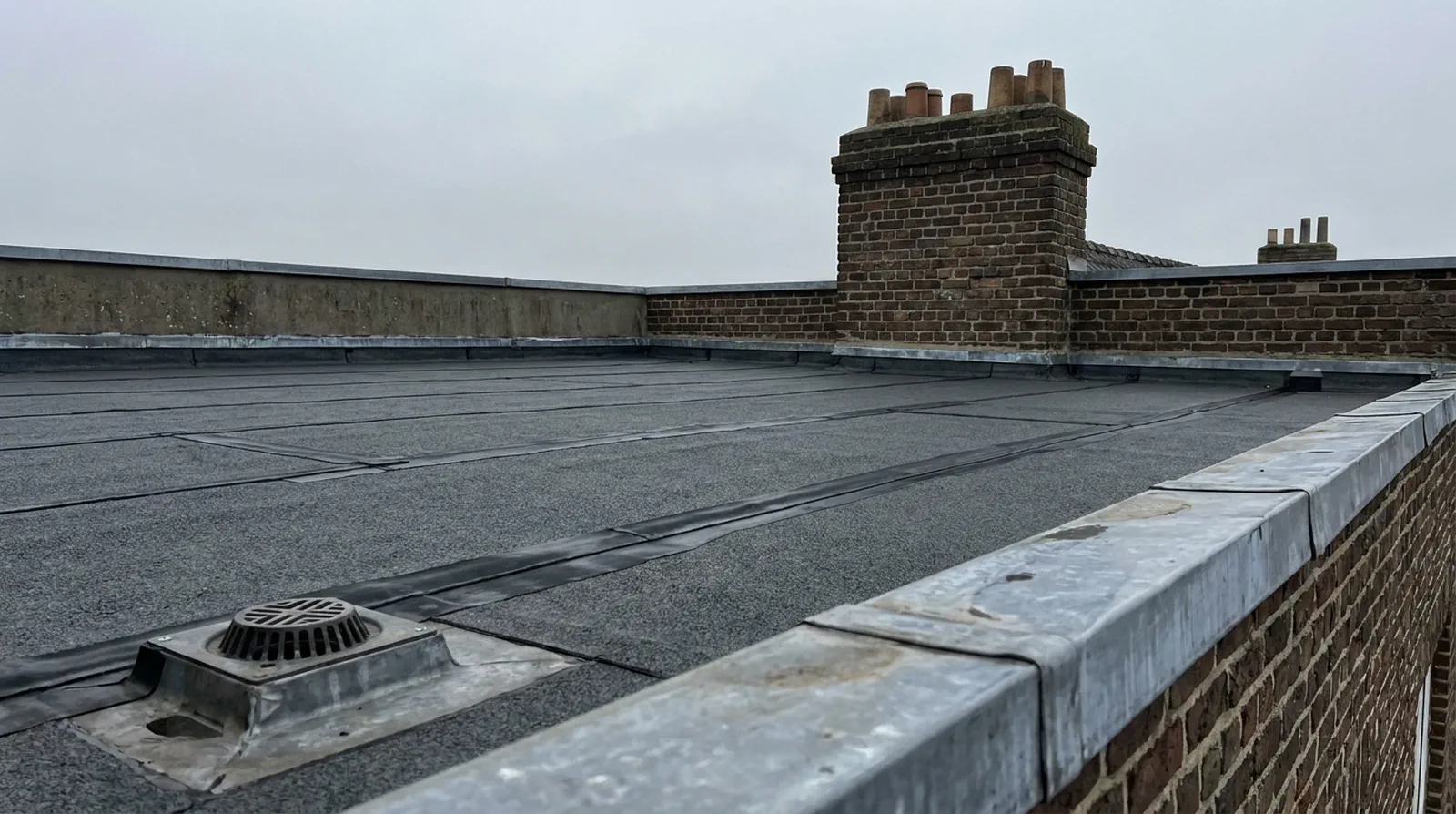
The upstand against the wall. The membrane has to run up at least fifteen centimetres and be mechanically clamped at the top, with a termination bar chased into the joint. Where that bar is missing and the membrane is only sealed with mastic, it ends up peeling away — usually on the party wall side, where nobody looks.
The penetrations. A vent, a cable entry or a chimney stack goes through the open field. Each of those points needs a proper finish; a bead of mastic around a pipe is not a finish.
The rainwater outlet. When the outlet sits too high or the fall is wrong, a puddle stays there permanently. Water that does not drain away ends up finding every weakness. A puddle still there after two days of dry weather is a diagnosis in itself.
The junction with the slope, where the extension backs onto the main roof. Two systems meet there, and that transition is the classic weak point.
Bitumen felt or EPDM
Bitumen felt — “roofing”, as it is called in Belgium — is laid in two layers, torched or bonded. It is a proven system, repairable with a torch, and most of the existing flat roofs in Belgium are still covered with it. Drawback: a lot of seams, and bitumen hardens over the years, which creates hairline cracks wherever the material moves.
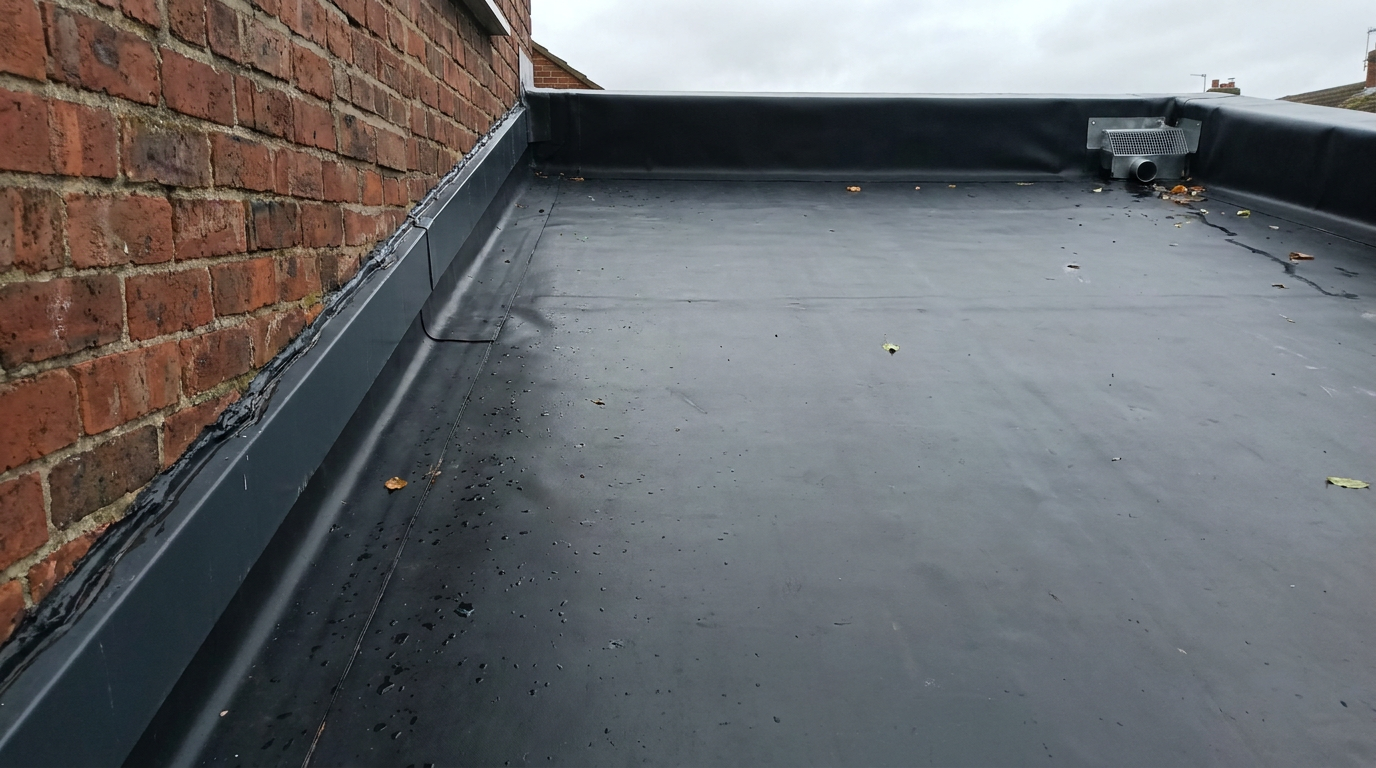
EPDM is a rubber membrane which, for small and medium areas, comes in a single piece. No seam in the open field means fewer places where something can go wrong one day, and the material stays flexible in freezing weather. Drawback: a repair needs the right adhesive and a clean surface, and the membrane is more vulnerable to sharp objects during laying.
For a typical extension of about twenty square metres we almost always go for EPDM in a single piece. For larger areas, or where the existing build-up is still sound and needs only a second layer, bitumen felt remains the logical choice.
Why insulation and waterproofing go together
When you are replacing the waterproofing anyway, the roof is open. That is the only moment when fitting insulation does not cost a fortune. If you do not do it, the extension stays the coldest room in the house — and one day you will open that roof up again, with the same stripping and disposal costs.
The order matters: vapour barrier at the bottom, insulation in the middle, membrane on top. In that order. Insulation laid over a membrane that is acting as a vapour barrier, or a vapour barrier that stops halfway, causes condensation between the layers. That moisture has nowhere to go and rots the deck from the inside.
This service in your municipality
- flat roof waterproofing in Tienen
- flat roof waterproofing in Grimbergen
- flat roof waterproofing in Vilvoorde
- flat roof waterproofing in Zaventem
- flat roof waterproofing in Machelen
- flat roof waterproofing in Brussels
- flat roof waterproofing in Schaerbeek
- flat roof waterproofing in Anderlecht
- flat roof waterproofing in Ixelles
- flat roof waterproofing in Uccle
- flat roof waterproofing in Molenbeek-Saint-Jean
- flat roof waterproofing in Jette