Key points
- A damp patch at the top of a party wall, on the inside, often comes from the junction between your roof and the taller wall next door.
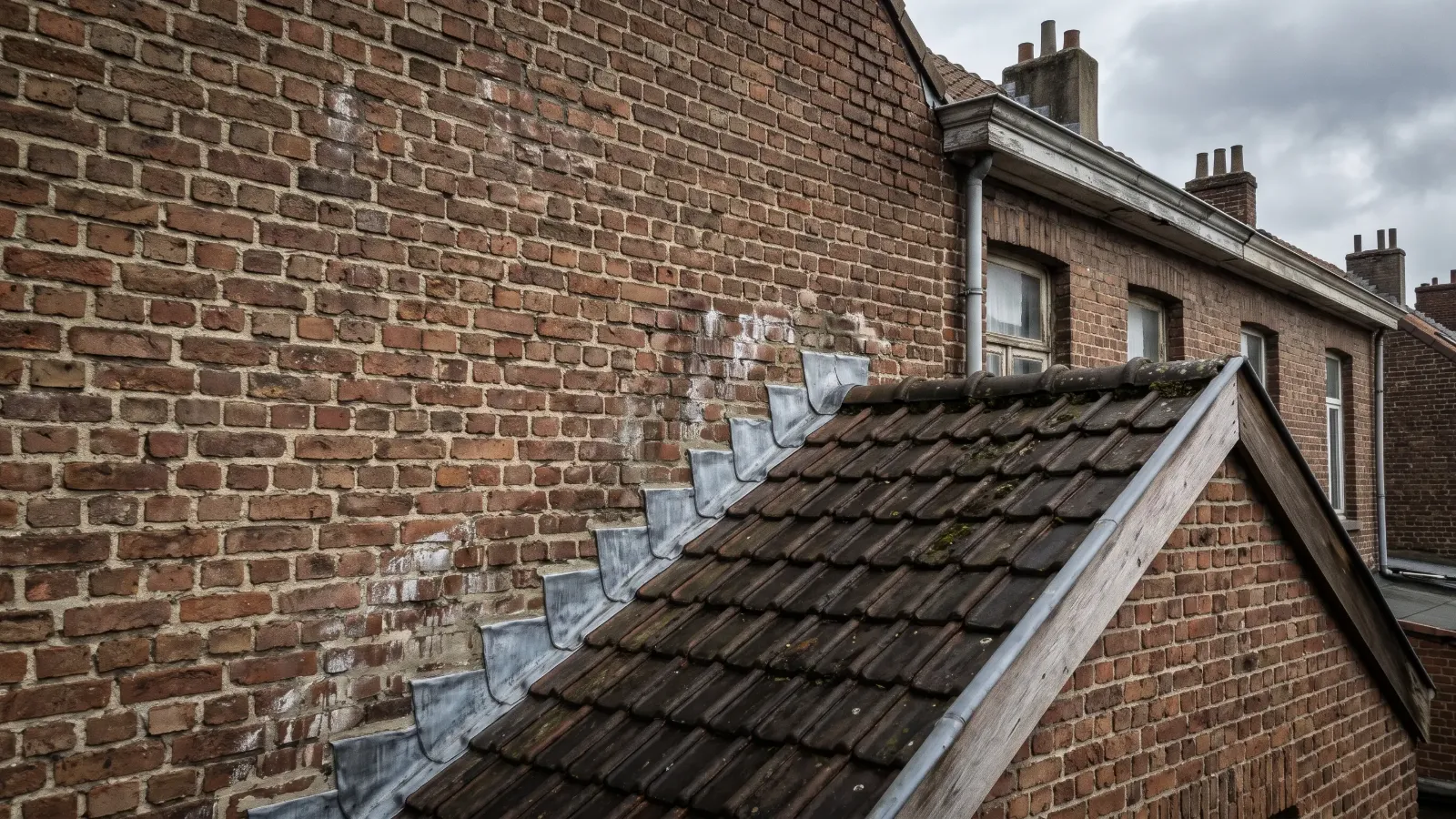
- A sound flashing is tucked into a chase cut in a mortar joint, never simply stuck to the face of the brick.
- The repair involves the neighbour’s wall: talk to them before the work starts.
Why the junction with next door lets water in
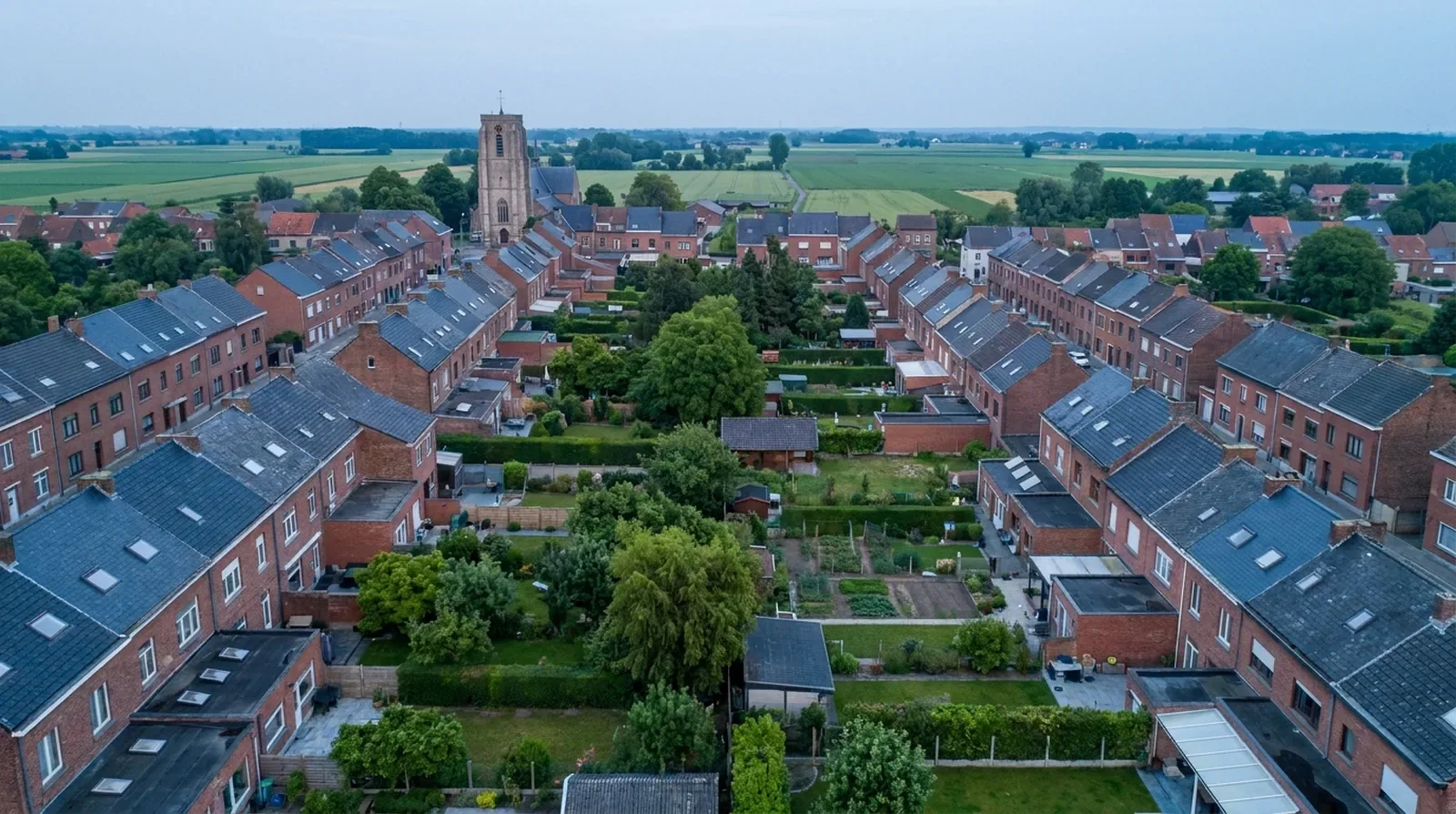
In Brussels, Vilvoorde, Halle or the centre of Leuven, streets were built house by house, in different periods. A low house stands next to a three-storey building, and a roof redone in the eighties meets an original covering. Almost everywhere this produces the same situation: a roof slope that runs into a taller party wall.
That junction takes water from two directions:
- water running down your slope, along the wall, towards the gutter;
- water streaming down the face of the neighbour’s wall and landing on your roof from above.
Sometimes there is a third source: the neighbour’s downpipe emptying onto your roof instead of into a gutter. The flow then concentrates on a handful of tiles, often the very ones against the wall. The whole junction has to send all of that water back onto the roof covering, without a single drop slipping between the metal and the brick.
Signs that point to the junction
Indoors, the mark sits at the top of the party wall in the top-floor room, roughly following the slope of the roof. Wallpaper lifts, plaster turns powdery or blisters, and the corner starts to smell musty. It gets worse mainly after wind-driven rain, less after light drizzle.
In the loft, if there are boards to walk on, look at the masonry where the underlay meets the wall: darker brick, a wet line down a rafter, mortar that crumbles when you touch it.
From the street, the garden or a window opposite, look for:
- a strip of metal pulling away from the wall and leaving a gap;
- a bead of mastic that has cracked or half come away;
- a hollowed-out joint just above the metal;
- moss or plants growing in the corner.
One check before blaming the junction: a party wall that backs onto an unheated loft next door, or onto an empty house, turns cold in winter. Air from your room condenses on it, especially in the morning, and black specks appear in the corner in cold, dry weather. That pattern follows the thermometer, not the rain. So for two or three weeks, note when the patch grows: if it spreads after every windy shower, the junction is the likely culprit; if it spreads during dry frost, probably not.
On a front elevation with a concealed box gutter, the end of that gutter against the party wall is another classic suspect. We cover it in our article on the box gutter hidden behind the cornice.
How the junction should be built
A lasting junction is made of two parts that overlap, each with its own job.
Under the covering: the upstand
Along the wall, a zinc strip runs under the tiles and turns up against the brick to a good height. With slates, small folded pieces called soakers are usually slipped under each course instead. This part catches the water running down the slope and leads it to the gutter.
Above it: the cover flashing
A second strip covers the upstand. Its top edge is folded and pushed into a chase cut into a mortar joint, which is then repointed. Water running down the wall slides over the flashing and drops back onto the roof covering, instead of getting behind the upstand. Where the roof pitch cuts across the brick courses at an angle, the flashing follows the joints in steps.
The faults we come across
- a flashing simply stuck to the face of the brick with mastic, with no chase;
- an upstand that is too low, so wind-blown water gets over it;
- zinc fixed too rigidly, which splits as it expands;
- an old cement fillet at the junction that has cracked and now lets water in instead of shedding it;
- a chase whose mortar has crumbled, so the flashing stays in place more by habit than by fixing.
The possible repairs
It all depends on which part has failed. If the upstand is sound and only the cover flashing is at fault, a clean chase is cut into the joint, a new flashing is made to length, wedged in place and the joint is closed again. This is the most common case. After the repair, give the wall time to dry out before redecorating indoors: masonry that has been taking in water for months needs a while to give it back.
If the upstand itself is perforated or too short, the course of tiles along the wall has to come off. We check the rafter ends and battens that may have soaked up water, repair the underlay against the masonry, and then fit upstand and flashing together. The principle is close to that of a roof valley that lets water through: we rework a strip of roof covering, not the whole slope.
One case must not be missed: a junction in good condition and a damp patch that will not go away. The water is then coming through the neighbour’s wall itself, through washed-out joints or a soft brick facing west. The fix lies on the face of that wall, with repointing or a suitable treatment, which requires the owner’s agreement. Our roof covering and renovation page explains how we rework flashings, valleys and junctions on site, and our made-to-measure zinc work covers shaping and soldering the parts.
Tell the neighbour before the work starts
Whether the wall is shared or belongs entirely to the house next door, the flashing is anchored in its masonry. You do not cut into it without talking first. A few precautions make that conversation easy:
- let your neighbour know as soon as the cause is identified, with photos;
- explain what will be done to their wall: a chase cut in one joint, filled again afterwards, without touching their roof;
- photograph their wall before the work, so nobody argues later about its original condition;
- if they have damp on the same side, have both houses looked at during the same visit.
In the vast majority of cases we work from your roof and your side, without going through next door. If water is already running down the wall into the house, a tarpaulin against the junction limits the damage until the repair can start, through our emergency roofing service.
Common questions
It lasts a winter, rarely more. Stuck to the face of the brick, it lets water run behind it as soon as it cracks, and a lasting junction needs a chase in the joint anyway.
Yes. A tall west-facing wall with hollow joints soaks up rain and releases it lower down, on your side. We check both before suggesting anything.
Almost never: the junction is reworked from your own slope. If there is no other way in, we tell you before the quotation so you can discuss it together.
Zinc is fine in most cases. Lead is easier to dress over heavily profiled tiles and is often found on older houses; we follow what the roof covering needs.
This service in your municipality
- roof renovation in Tienen
- roof renovation in Grimbergen
- roof renovation in Vilvoorde
- roof renovation in Zaventem
- roof renovation in Machelen
- roof renovation in Brussels
- roof renovation in Schaerbeek
- roof renovation in Anderlecht
- roof renovation in Ixelles
- roof renovation in Uccle
- roof renovation in Molenbeek-Saint-Jean
- roof renovation in Jette