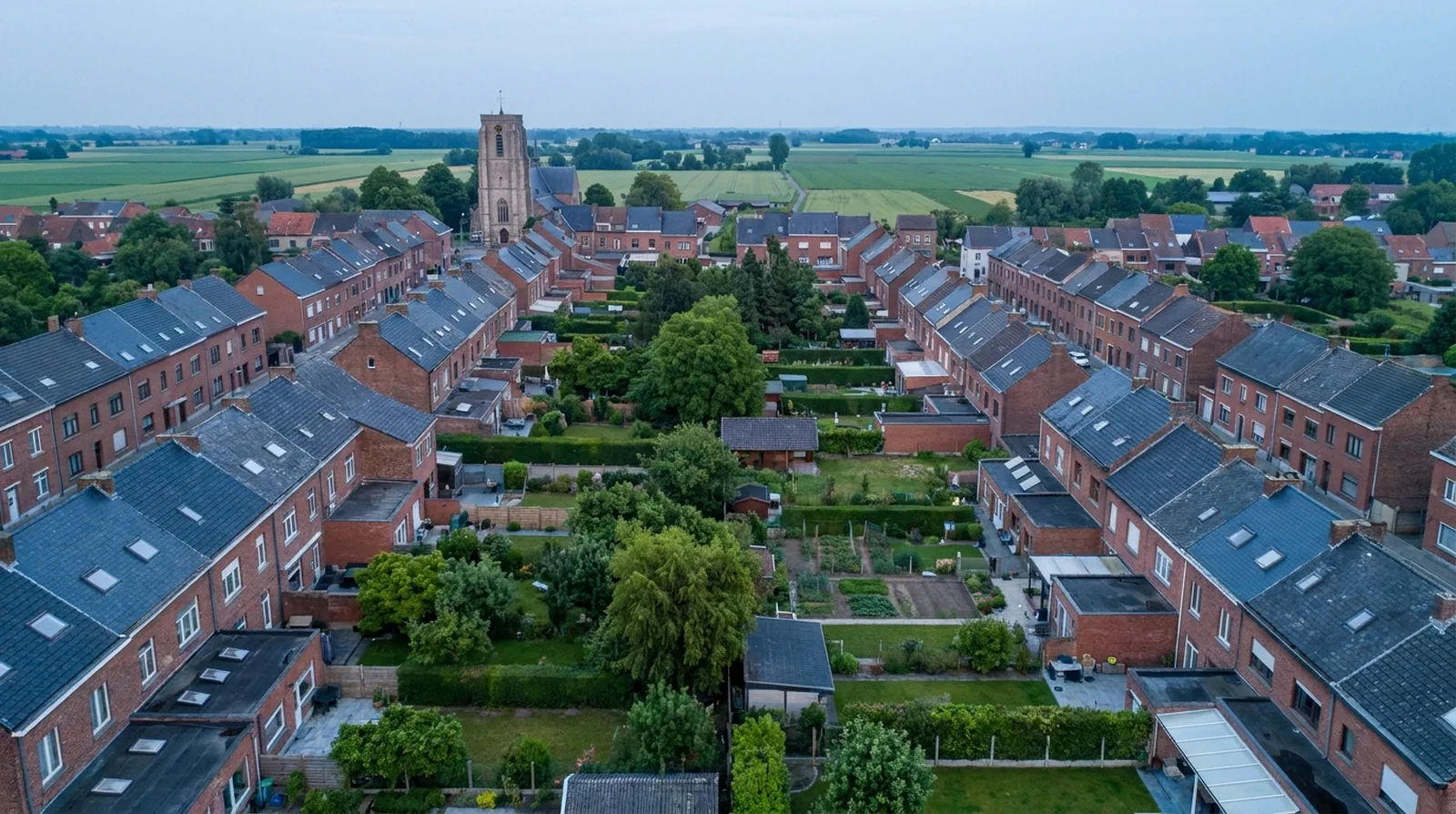
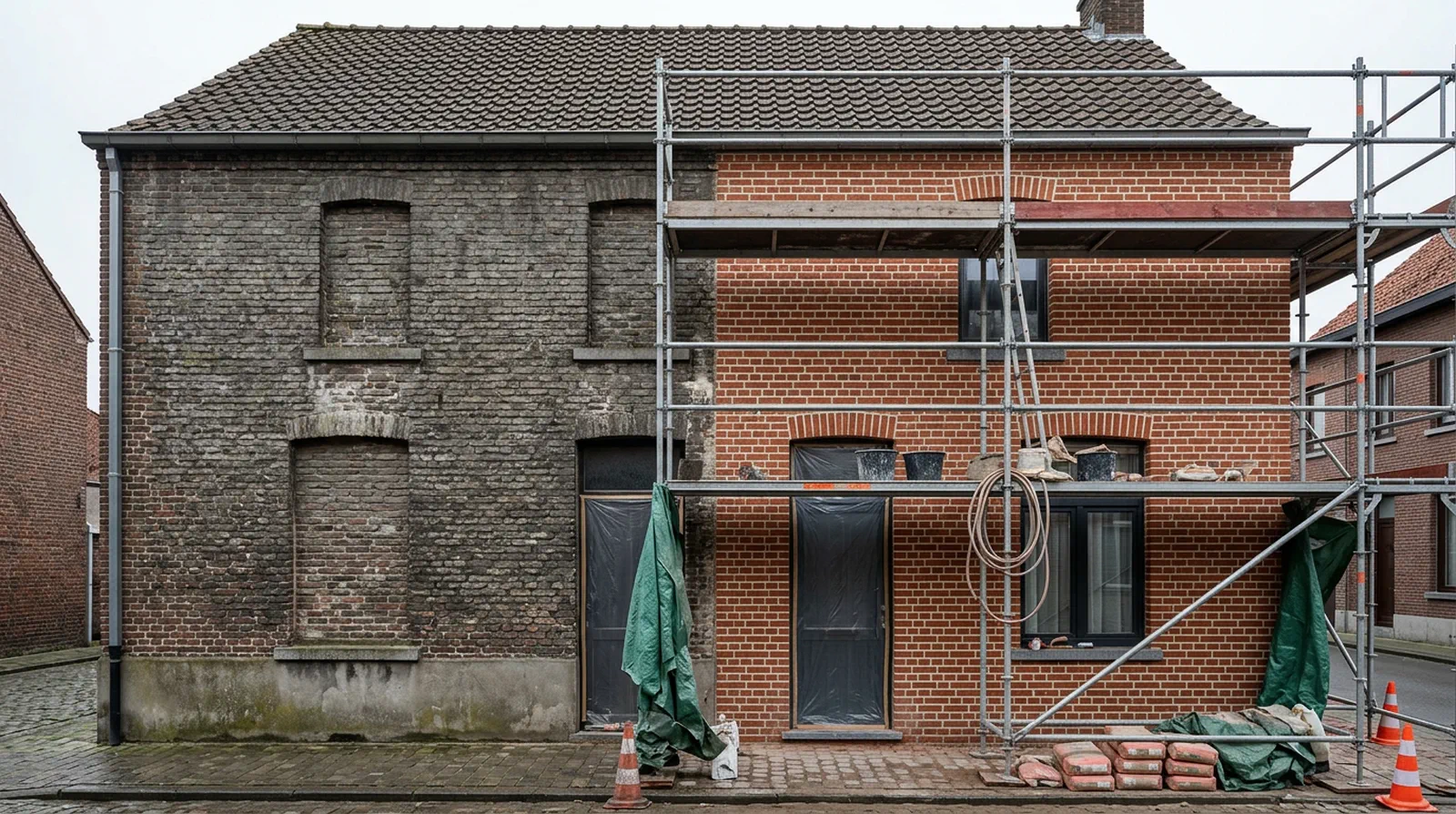
Roof and facade are almost always treated as two separate jobs, when in fact they meet at one point: the cornice. That is where the water from the roof meets the facade, and that is where most damp problems begin.
The cornice is the weak link
On a Belgian terraced house the cornice overhangs the facade and carries the gutter. It is in timber, render or stone, and it is loaded from three sides: from above by the water off the roof, from the front by driving rain, and from behind by whatever is going on in the box gutter.
When that box gutter leaks, it is not the facade that gives the first signs but the cornice: the timber swells, the render cracks, and only afterwards does the damp stain appear on the wall. Repairing a facade without dealing with the gutter above it therefore makes no sense — and that is precisely the work we most often have to do again.
What really damages a facade
Rarely the rain itself. Almost always water concentrated somewhere: an overflowing gutter, a badly connected downpipe, a sill with no weathering upstand, or a plinth that is no longer protected from splashback.
On older masonry facades there are the joints as well. Washed-out joints let the water in; hard cement joints on soft brick do the opposite, they shut it in. That second mistake dates from the seventies and eighties, and we come across it regularly in Schaerbeek and Forest.
Solving the problem therefore starts with taking the water elsewhere. Only after that does cleaning, repointing or treating make any sense.
The scaffolding: the argument that counts
On an ordinary terraced house the scaffolding is not a detail in the quotation. Erecting, hire, dismantling, and in town the road occupancy and the parking ban: it all adds up, and it adds up the same whether you carry out one job up there or three.
That is why, when we come to survey a roof, we always raise the question of the facade. Not to sell: to stop you paying for the same scaffolding again in two years for repointing we could have done now.
The same goes for painting the cornice, for a roof window you were meaning to fit one day, and for the chimney. Everything that is done at height belongs to the same conversation.
In Brussels: the regulations first
You cannot do as you like with a Brussels facade. Cornices, decorative render, facing stone and even the colour of the joints often fall under the municipal planning regulations, and in a protected area the opinion of the heritage department is added to that.
That is not a reason to do nothing, but it is a reason to start early. We check the rules in your commune before the quotation and tell you what goes through without a permit, what needs a notification, and what turns into a file taking several months.
In Flanders the rules are generally more relaxed for putting something back like for like, but as soon as the appearance changes — a different brick, a different colour, external insulation — the principle is the same.
This service in your municipality
- facade renovation in Tienen
- facade renovation in Grimbergen
- facade renovation in Vilvoorde
- facade renovation in Zaventem
- facade renovation in Machelen
- facade renovation in Brussels
- facade renovation in Schaerbeek
- facade renovation in Anderlecht
- facade renovation in Ixelles
- facade renovation in Uccle
- facade renovation in Molenbeek-Saint-Jean
- facade renovation in Jette