
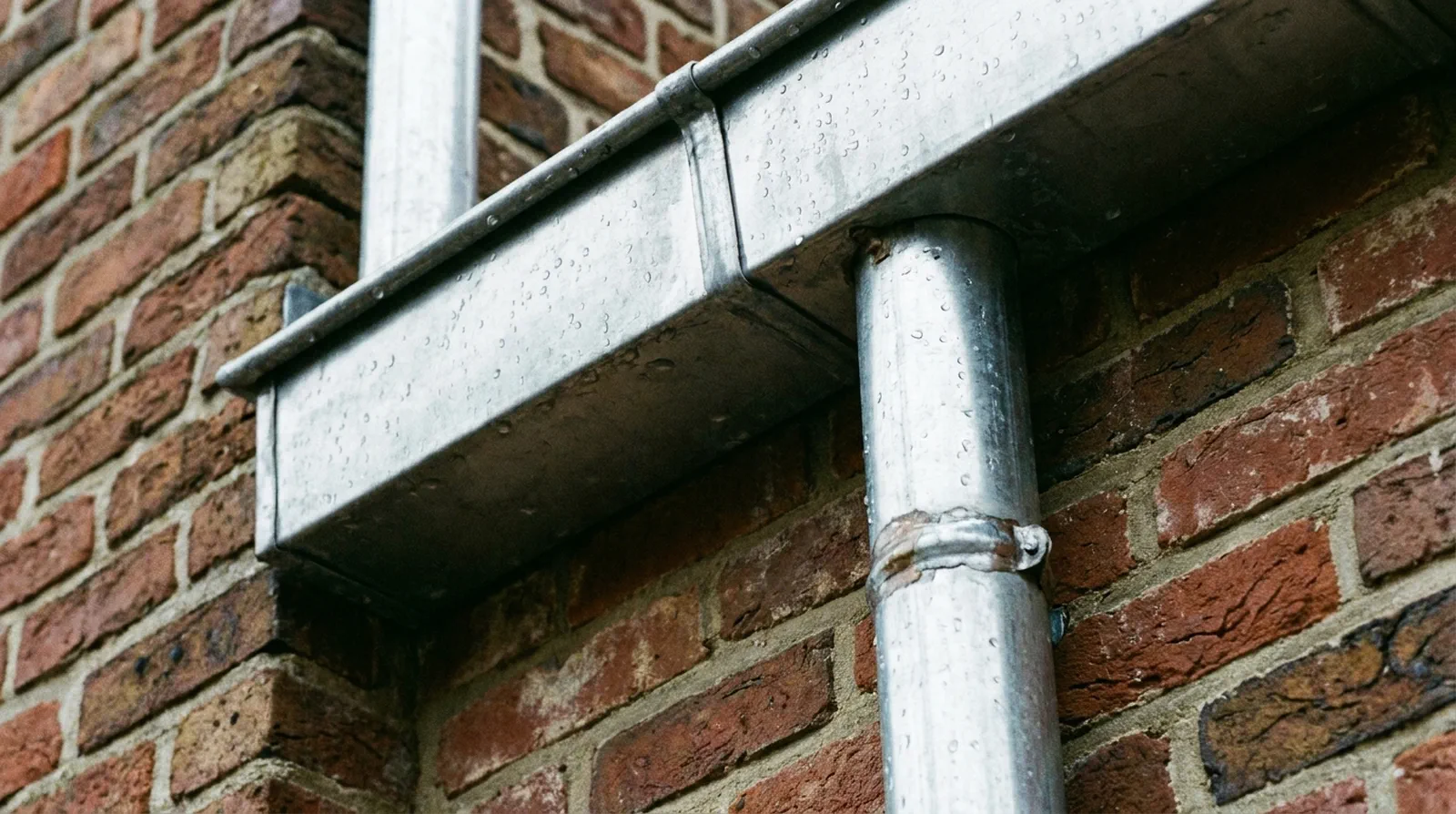
Belgian housing stock has two families of gutter, and they behave in radically different ways when they fail. Knowing which one you have determines how urgent a problem is and how to keep an eye on it.
The hanging gutter
The hanging gutter is suspended from brackets under the verge, visible from the street. It comes in zinc, galvanised steel, copper or PVC. The advantage is obvious: anything wrong with it can be seen. A leak drips onto the ground, a blockage sends the water over the edge, a loose bracket makes the gutter sag.
The maintenance matches: clear out and flush once or twice a year, depending on the trees around it. In Dilbeek, Meise and Overijse, where the gardens are old, twice a year is nothing excessive.
The concealed box gutter
The box gutter sits behind the cornice, on the head of the wall, and stays invisible from the street. You find it on almost every terraced house in Vilvoorde, Halle, Leuven and the Brussels core. The water runs there in a zinc or lead trough laid on a timber deck — and that is the whole difference: when that trough leaks, the water does not go outside but inside.
The result is a leak that goes unnoticed for months. The water gets into the head of the wall, spreads between the leaves of the cavity and eventually appears as a brown ring on the ceiling upstairs, often several metres from the real cause. Anyone who repaints that ceiling at that point will be repainting it next year.
The expansion joint decides
Zinc expands and contracts with temperature. A ten-metre trough soldered continuously from wall to wall has nowhere to move: it cracks again within a few years, however careful the soldering. The expansion joint, at the right spacing, is therefore not a finishing detail but the part that decides the service life.
Just as decisive: what lies underneath. When the timber deck has rotted, the bottom sags and the water stands instead of running to the outlet. A new zinc trough on a rotten deck is wasted work — the fall has to be re-established first.
Finally the junction with the wall: it is dealt with by an upstand and a cover flashing chased into the joint, not with mastic. Mastic is a two-year repair. It happens more often than you would think, and it is generally the first thing we find when a box gutter “recently redone” starts leaking again.
This service in your municipality