
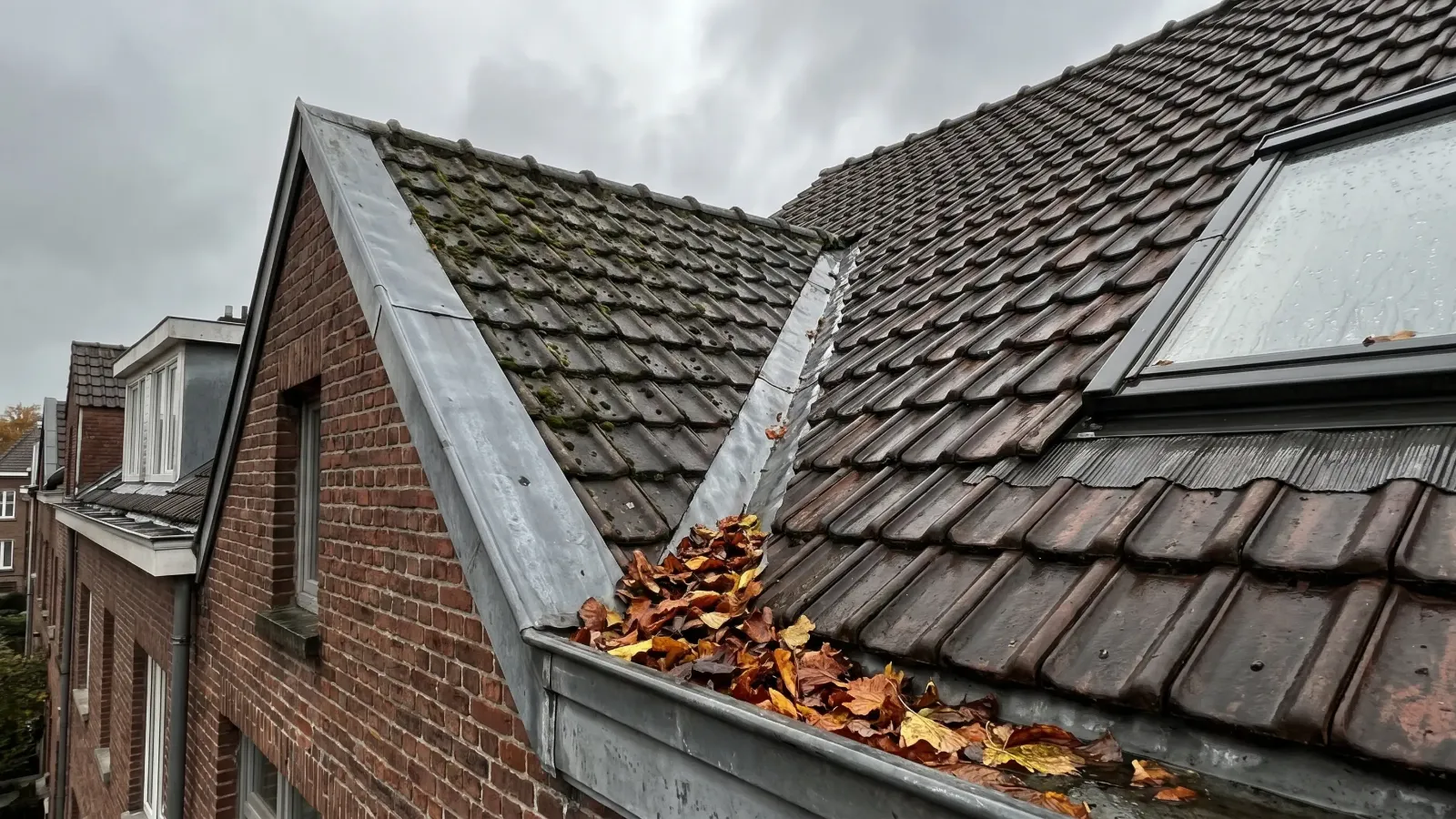
Key points
- A valley gathers the water from two slopes: once the leaves have fallen, it is the first place to keep an eye on.
- A wet streak under the inside corner of the roof, in the loft or in the corner of a ceiling, points towards it.
- Sometimes cleaning is enough; a perforated or undersized valley is replaced along its whole length.
A valley is where two roof slopes meet
The valley is the inside corner where two roof slopes join: an L-shaped house, an extension whose roof runs into the main slope, a dormer, or a corner house where two roofs cross. All the rain that falls on those two slopes ends up in a single line. In a heavy shower, the flow there is far greater than on an ordinary slope.
In this part of Belgium you will mostly find two types:
- the open valley, the usual choice under tiles: a zinc lining, sometimes lead on older houses, that stays visible between two rows of tiles cut at an angle;
- the closed valley, more common under slates: the roof covering meets in the middle and a small piece of metal is slipped under each course.
Either way, the valley does not rely on glue or sealant to stay watertight. It relies on laps: the metal runs far enough under the tiles that the water never reaches its edge. That safety margin disappears as soon as something slows the water down.
What you can see without going on the roof
Start indoors. If your loft is accessible and has boards to walk on, follow the rafter that runs along the inside corner with a torch, ideally the day after rain. A dark streak on the timber, a teardrop-shaped stain on the underlay or damp, slumped insulation under that line almost always points to the valley.
Without a usable loft, the trace shows up further away: in the corner of the ceiling of the room below, or at the top of an internal wall. It can then look like condensation. Our article on a damp stain that could be a leak or condensation helps you decide by noting when the stain darkens.
Outside, stay on the ground or behind a window. The zoom on your phone is enough to spot:
- a mat of leaves, pine needles or moss lying in the valley;
- edge tiles that have shifted and no longer follow a straight line;
- water shooting out at the foot of the valley and over the gutter during a downpour;
- streaks or green marks on the wall just below the corner.
Take photos and note the date. They help the roofer prepare the visit, and they help your insurer if damage appears indoors as well.
Four causes, from the simplest to the most serious
A dam of leaves
In November this is the most common cause by far. Leaves slide off both slopes and pack into the valley. Once wet, they form a dam: water builds up behind it, rises over the edge of the metal and runs under the tiles. In the leafy streets of Kraainem, Wezembeek-Oppem or Uccle, a single autumn gale can fill a valley. Moss does the same on slopes that see little sun, as we explain in our article on moss that starts to block the water.
A worn valley lining
Zinc hardly wears on its upper face. It wears from underneath, when moisture stays trapped against it, and at the folds where the metal was worked. It ends up with pinholes or a long split. On old Brussels houses, a lead lining may also have buckled after years of expanding and contracting.
A valley that is too narrow, or laps that are too short
If the tiles were cut too close to the centre, or the metal does not run far enough under them, there is very little margin. Rain driven by a westerly wind is then enough to push water sideways. The fault often dates back to the original installation; it only shows itself on the day the flow increases.
Cut tiles that have moved
Along an open valley, each course ends with a tile cut at an angle. Those small pieces hold poorly unless each one was fixed individually. A single piece sliding into the valley slows the water, catches leaves and opens a path to the course above.
Clean, repair or replace: how we decide
The answer becomes clear on site, once the valley has been cleared. Three situations come up again and again.
- The metal is sound and the tiles are secure: a thorough clean of the valley and of the gutter that receives it is enough. While we are there, we check the edge tiles and the bottom of the valley, where the water arrives with the most force.
- The fault is local: a cut tile to refix, a lap to rework. The repair stays small. Soldering a patch onto zinc that has thinned over the years, on the other hand, rarely lasts: solder does not bond well to tired metal.
- The lining is perforated or too narrow: the valley is replaced along its whole length. We lift the strip of tiles on each side, check the boards and the underlay, lay a new lining in lengths that overlap and can expand, then cut and fix every edge tile again.
Mastic, silicone or self-adhesive aluminium tape buy you a few weeks. They come away at the first frost and hide the defect just when you need to see it. We only use them to bridge the gap until the proper repair.
Valleys are part of the zinc work we shape and solder on site, along with flashings and junctions. When we replace a valley, we also look at the gutter below it: it takes the water from two slopes and has to be able to cope with it.
Until the repair: limiting the damage from indoors
As long as water is coming in, a few simple steps stop the ceiling from following:
- put a container under the drip in the loft, standing on a board that spreads the weight;
- move soaked insulation aside so it can dry, without throwing it away: you may need to show it;
- if the water gets close to a light fitting or a junction box, switch off that circuit at the fuse board;
- note the days when the leak comes back: after every shower or only when rain comes with wind, which points the search in a different direction.
If water is pouring in, the valley can be covered with a tarpaulin until the repair can start: that is the purpose of our emergency weatherproofing for leaks. In other cases a visit is enough. Through the online quote request you can attach the photos you took from the ground, so we know where to look first.
Common questions
Yes, when the metal lining is intact and the edge tiles are secure. Cleaning has a second benefit: it uncovers the metal, and that is when you can see whether it is pitted or split.
We usually advise against it. In a valley the guard itself traps the leaves and recreates the dam you wanted to avoid; a clean after the leaves have fallen works better.
Rarely. We rework the strip of roof covering on either side of the valley. If tiles break as they come off, or the underlay is in shreds further along, we show you the photos before going any further.
Under tiles, zinc is the most common choice in this region. Lead is mainly found on older houses and some slate roofs; the choice depends on the covering and the pitch, and it is stated in the quotation.
This service in your municipality