
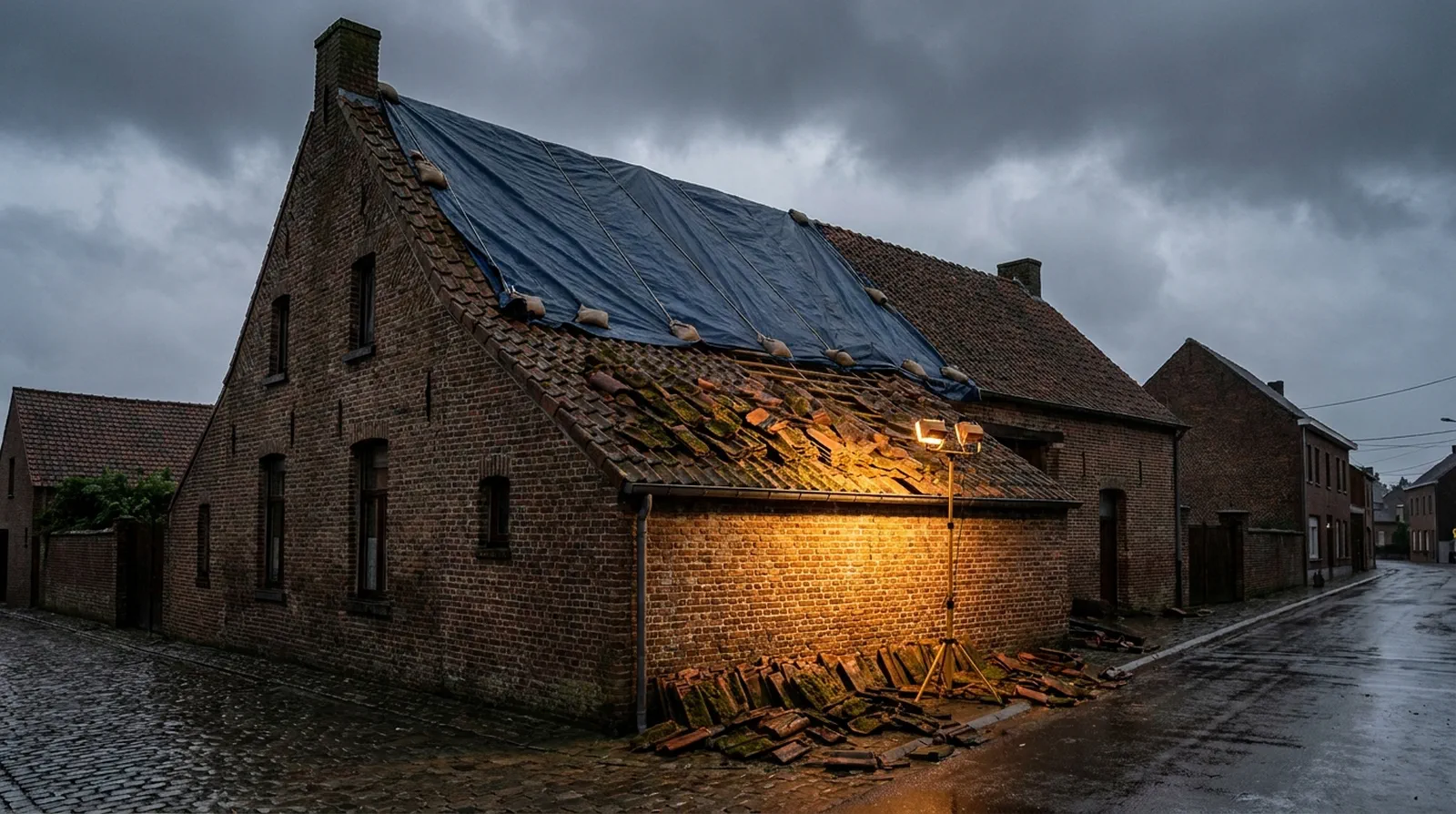
A brown ring on the ceiling upstairs is the most common reason people call us. In about half the cases it is a leak. In the other half it is condensation — and then a new tile solves nothing.
Four differences you can see for yourself
The timing. A leak appears during or just after rain, then dries out. Condensation appears in cold weather, mainly in the morning, and has nothing to do with rainfall. Note down for two weeks when the stain darkens: that is usually enough to settle it.
The shape. A leak gives a stain with a sharp edge, often brown, because the water carries dust and timber with it. Condensation gives a diffuse, greyish area, sometimes speckled with black mould.
The place. A leak follows gravity and the beams; it often comes out several metres from the cause. Condensation settles where it is cold: against the external wall, in the corners, around the dormer — so always in the same places.
The extent. A leak grows with every shower and then stays as it is. Condensation comes and goes with the season and almost completely disappears in summer.
Why water rarely comes straight down
That is why owners so often look in the wrong place. Water coming in through a broken tile or a tear in the roofing underlay does not fall straight down: it runs across the breather membrane, then along a rafter, then along a beam, and comes out at the lowest point of that path.
That point can be several metres away, and it is almost never underneath the defect itself. That is why we go up and follow the trail back, instead of opening up the ceiling.
In a terraced house with a concealed box gutter it is the same but horizontally: the water gets into the head of the wall and spreads through the cavity before reappearing.
If it is condensation
Then the roof is not at fault and no repair will change anything. The cause is warm, humid indoor air getting into the cold build-up and condensing there. Three things then come into play: a continuous vapour barrier on the warm side, a clear air gap between the insulation and the roofing underlay, and adequate ventilation of the dwelling.
In practice it is almost always the vapour barrier that is missing or punctured — a downlight, a cable, an untaped lap. We find it regularly in lofts insulated some fifteen years ago, and it is precisely the subject we are consulted about most in Zaventem.
Act before winter. Wet insulation no longer insulates, and the timber around it starts to rot — at that point it becomes a roofer’s job again.
When waiting is not an option
When the stain grows after every shower, when water runs along a light fitting, when you can hear the plaster coming away, or when the ceiling starts to sag. That last sign means the water is in the structure and no longer just at the surface.
In all other cases there is still time to do it properly: establish the facts first, repair afterwards. Anyone who repaints the ceiling before finding the cause will be repainting it next year — and paying in the meantime for the damage underneath.
This service in your municipality
- damp treatment in Tienen
- damp treatment in Grimbergen
- damp treatment in Vilvoorde
- damp treatment in Zaventem
- damp treatment in Machelen
- damp treatment in Brussels
- damp treatment in Schaerbeek
- damp treatment in Anderlecht
- damp treatment in Ixelles
- damp treatment in Uccle
- damp treatment in Molenbeek-Saint-Jean
- damp treatment in Jette