Key points
- Compare item by item, not the total: access, strip-out, waste, roof timbers, underlay, covering, zinc work, insulation.
- An item that is missing is not included for nothing: it will come back as an extra, or it will not be done.
- Materials must be named precisely, and the VAT rate applied must be stated.
Put both quotations on the same grid
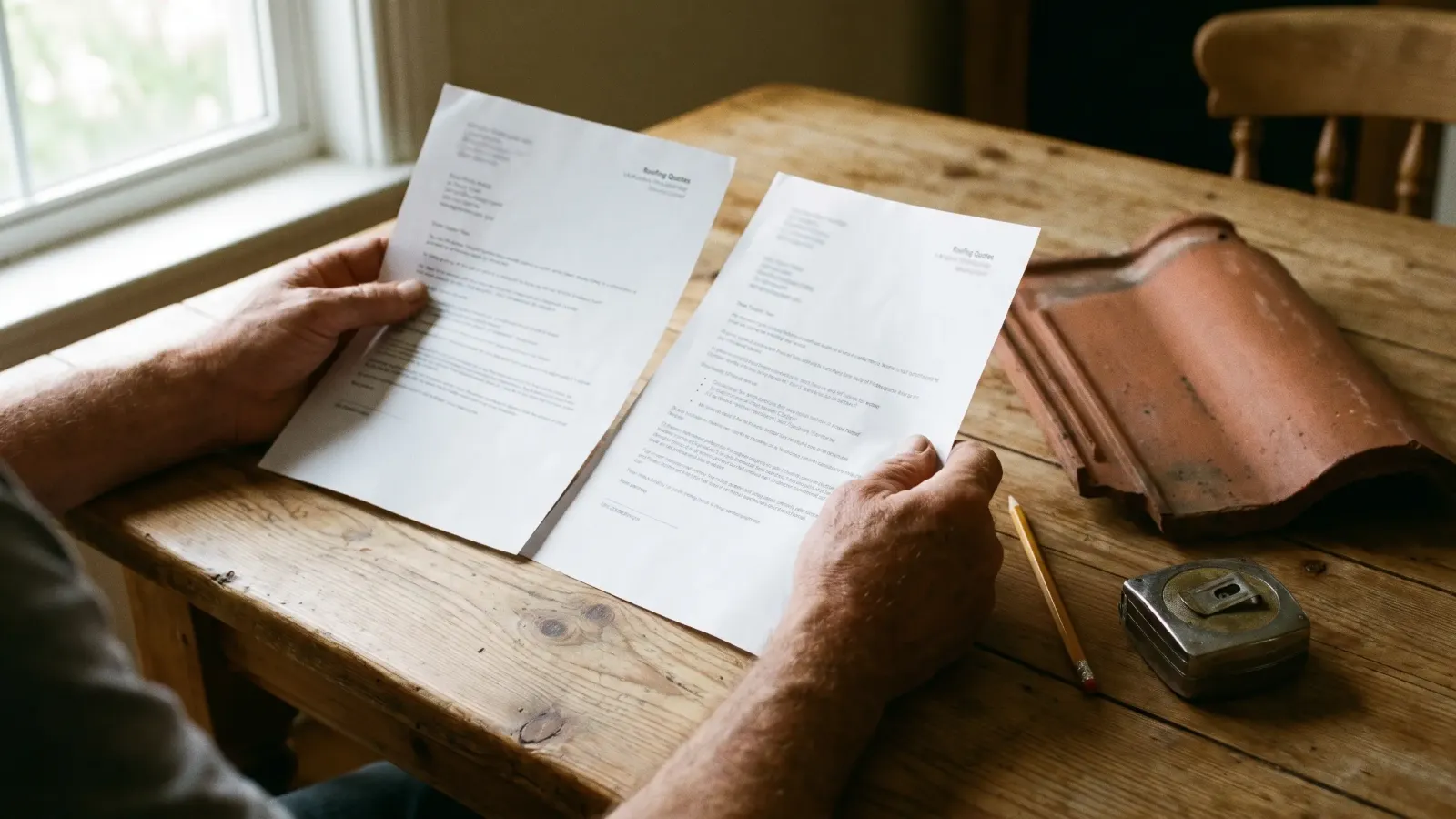
Take a sheet of paper and draw two columns, one per contractor. In the rows, list the real stages of a roof renovation, in the order they happen on site:
- 1.access: scaffolding, cherry picker, protection for the garden and the facade;
- 2.stripping the old covering and taking the waste away;
- 3.checking the roof timbers and repairing them if needed;
- 4.the support: counter-battens and battens;
- 5.the underlay;
- 6.the new covering and its fixings;
- 7.verges, ridge and ventilation;
- 8.zinc work: gutters, downpipes, valleys, flashings, chimney junction;
- 9.insulation and the vapour control layer, if the project includes them;
- 10.final clean-up and making good around the house.
For each row, note three things: is the item in the quotation, in what quantity, and with which material. Very quickly, the gap between the two totals explains itself. It rarely comes from a different price for the same thing; it almost always comes from different things.
If one of the quotations is a lump sum with no detail, ask for a breakdown. A contractor who has actually measured your roof can say what each stage represents; if they refuse, that tells you something too.
The items most often left out
Access to the roof
On a terraced house in town, the scaffolding takes up the pavement and sometimes part of the road. That involves an application to the commune and signage. Ask who arranges it and whether it is priced. A quotation that says nothing about it leaves the organisation to you, or keeps it in reserve for a later invoice.
Taking the waste away
A stripped roof fills several skips. Transport, sorting and disposal have a real cost. If there are corrugated sheets or fibre-cement slates laid before 2001, the item changes completely: read our article on corrugated sheets and asbestos before you compare.
The roof timbers
Nobody knows the exact condition of the rafters until the roof is open. An honest quotation says so and sets out how extra timber work will be charged: a price per rafter replaced, per metre of batten, per metre of wall plate. A contractor who allows for nothing is not necessarily wrong about the timber, but you will have no reference point on the day a decision has to be made. Where timber suffers first is described in our article on the roof structure.
The junctions
Valleys, flashings against a party wall, verges, the junction with a chimney or a roof window: these are what leak, far more than the main area of the roof. The phrase ‘junctions to be checked if necessary’ says neither which ones nor how. Ask for them to be listed.
The bottom and the top of the slope
At the eaves, the underlay should discharge into the gutter through a strip designed for that purpose, not stop on the fascia board. At the top, a ventilated ridge lets out the air that circulates under the tiles. In a complete quotation these details take up one line; when they are missing, you discover them years later, through stains on the cornice or condensation under the covering.
Read the materials, not just the words
‘Tile’ says nothing. ‘Clay tile, this model, this colour, fixed with stainless steel clips’ says everything. The same goes for the rest:
- underlay: the type of membrane, and how it is finished at the eaves and around penetrations;
- zinc work: the metal, its thickness, how it is joined, soldered or glued;
- insulation: the type, the thickness and the R-value, with or without a vapour control layer;
- fixings: nails or clips, and what they are made of.
‘Or equivalent’ is only acceptable if the equivalent is defined by its properties. Otherwise two quotations that look identical on paper can produce two very different roofs.
If you plan to apply for a grant for the insulation, those technical details often have to appear on the invoice. We include them as standard in our roof insulation quotations, so the application does not stall at the last minute.
Clauses that prevent unpleasant surprises
- Unforeseen work: the quotation should say how it is handled. With us, every extra is shown on photos and priced before it is carried out; at the very least, insist on written agreement.
- Keeping the house dry during the work: ask how the house stays weathertight every evening, especially in the rainy season.
- The schedule: an indicative start date and what happens in bad weather. Roof work stops in high winds or heavy rain, which is normal; the house simply has to stay covered while it waits.
- The payment schedule: a reasonable deposit on ordering, the balance after handover, and nothing paid for work that has not started.
- Handover: a joint inspection at the end of the job, with the list of documents you receive: photos, product sheets and, for any asbestos removal, the disposal document.
- Insurance: ask for the contractor’s insurance certificate before work begins.
What about VAT?
The VAT rate that applies to renovation work on a home depends on conditions set by the Belgian FPS Finance. We do not reproduce them here, because they have to be checked case by case and they can change. Before you sign, check the FPS Finance website or ask your accountant, and make sure each quotation states clearly which rate is applied and on what basis. Two ‘VAT included’ totals calculated at different rates cannot be compared.
What you can ask for before choosing
A serious roofing quotation is prepared on site. The roofer should have looked closely at the covering, measured the surfaces, examined the junctions and, where possible, had a look at the roof timbers from the loft. Ask for the photos that justify each item: they let you check that both contractors saw the same roof.
That is how we work on every roof renovation: a photo report, a price item by item, and a clear line between what needs doing now and what can wait. You can request a visit by phone or through the quote form, and attach a competitor’s quotation if you would like us to read it through.
Finally, check how long each quotation remains valid and what happens if material prices rise in the meantime. If the work will only start months later, you could otherwise be comparing two quotations that no longer hold on the start date.
Common questions
Not necessarily. But a large gap almost always hides a missing item or a different material: put both quotations on the same grid before drawing conclusions.
Yes, and it is often clearer: one version with external insulation and one without, or two tile models. Each option should then state exactly what it adds or removes.
The roofer shows you the problem with photos and prices the extra before carrying it out. If the quotation included unit rates, the calculation is immediate.
For a rough idea, perhaps; for signing, no. The items that move the total, such as the timbers, the junctions or access, can only be judged on site.
This service in your municipality
- roof renovation in Tienen
- roof renovation in Grimbergen
- roof renovation in Vilvoorde
- roof renovation in Zaventem
- roof renovation in Machelen
- roof renovation in Brussels
- roof renovation in Schaerbeek
- roof renovation in Anderlecht
- roof renovation in Ixelles
- roof renovation in Uccle
- roof renovation in Molenbeek-Saint-Jean
- roof renovation in Jette