Redoing a roof without checking the roof structure is the most expensive way to save money. The new covering looks superb ten days later, and three years on a slope sags because the wall plate underneath stopped carrying anything long ago.
Why always at the verge
The timber in a roof does not rot of its own accord. It rots where it has been getting wet for years, and that is almost always in the same place: the ends of the rafters, where they bear on the wall plate — directly under the gutter.
In a Brussels or Vilvoorde terraced house with a concealed box gutter it is more pronounced still: the trough sits on a timber deck, and as soon as it leaks the water stands on the timber instead of draining away. When we open up a box gutter like that we always look at the rafter ends — that is where the bill is decided.
In the middle of the slope the timber is generally still perfect. That often surprises owners: they expect a general problem and learn that it comes down to two metres on one side only.
Rot or insects?
Two very different problems that get confused. Rot comes from damp: the timber darkens, goes soft and crumbles under a screwdriver. As long as the damp is there it spreads; once the source is removed it stops.
Insect damage is recognised by the holes and the fine dust underneath. Common woodworm attacks mainly the sapwood and generally stays manageable in Belgium. The house longhorn beetle is another matter: it tunnels whole galleries through softwood without the outside looking damaged at all, and it is present in our region.
The distinction determines the treatment. Rot is put right by taking out and replacing the wetted section, once the water ingress has been stopped. Insects call for a timber treatment, and sometimes for the replacement of whatever has been weakened.
Replace or reinforce
Replacing a whole roof structure is rarely necessary and almost always too expensive. In most cases it is enough to cut off the affected rafter ends and sister new pieces alongside them — a routine job, carried out while the roof is open anyway.
When the wall plate itself has gone, that is another matter: it carries the whole slope and is replaced in one piece, which means temporarily propping the roof. That is the scenario that pushes a quotation up, and it is exactly why we want to see the roof structure before the strip-out and not after.
In the old Brussels mansard roofs there is, on top of that, an old and slender structure that is better kept than replaced. There we work with local reinforcement and with the timber in place, as long as it is still carrying.
What you can check yourself
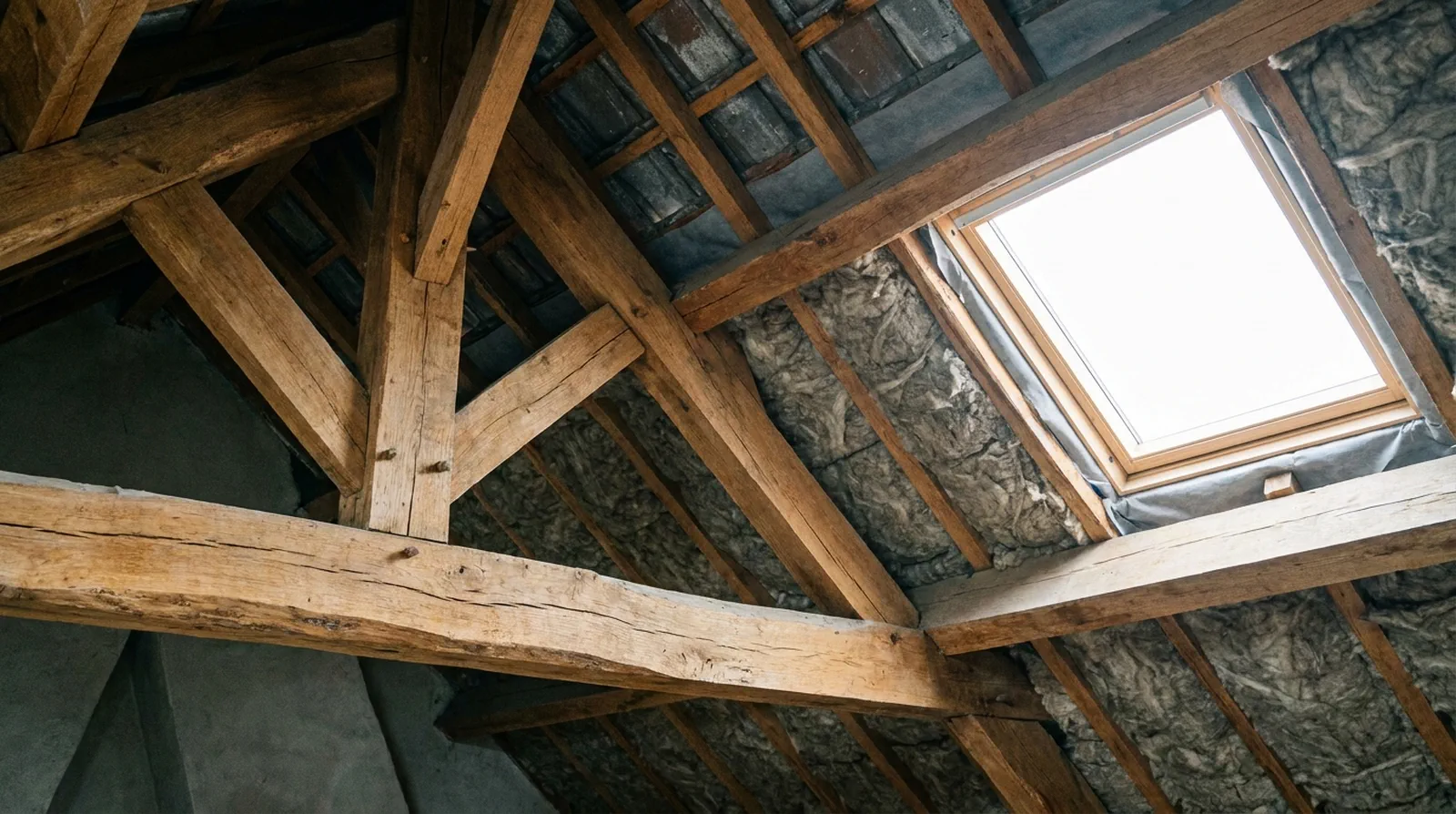
Go up into the loft with a lamp, preferably after a spell of rain. Do not look at the middle but at the edges: where the rafters meet the wall, and around the chimney stack. Look for dark patches, a white fluff of mould and timber that gives way when you push a screwdriver into it.
Look at the roofing underlay as well, if there is one. Tears, hanging strips or brown marks point to water that is already getting in. And look at the light: a line of daylight where there is no roof window means something is missing.
If you find one of these signs, there is no rush measured in days — but there is every rush measured in seasons. Damp that starts in autumn does the most damage in winter.
This service in your municipality
- roof structure work in Tienen
- roof structure work in Grimbergen
- roof structure work in Vilvoorde
- roof structure work in Zaventem
- roof structure work in Machelen
- roof structure work in Brussels
- roof structure work in Schaerbeek
- roof structure work in Anderlecht
- roof structure work in Ixelles
- roof structure work in Uccle
- roof structure work in Molenbeek-Saint-Jean
- roof structure work in Jette