
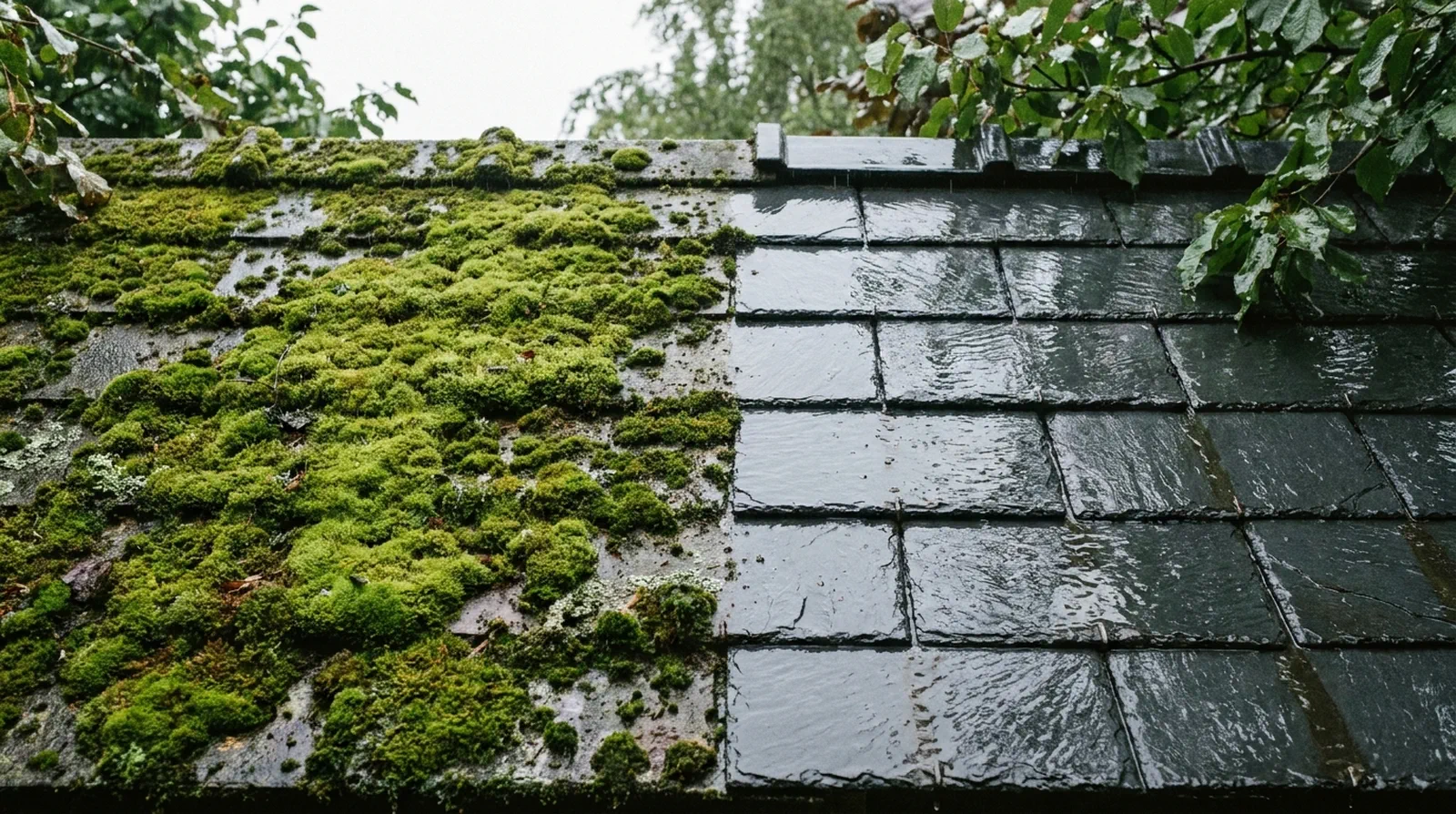
After every clean the same question comes back: should a water repellent be applied? The answer does not depend on your budget but on the material under your feet. On some tiles it is a sensible investment, on others it is pointless at best.
What the product does
A water repellent is not a coat that sits on top of the tile: it is a liquid that penetrates the pores and makes their walls water-repellent. The tile carries on breathing — water vapour still passes through — but liquid water is pushed back and beads.
The result: the tile absorbs less water, so it stays lighter, dries faster and suffers less from frost. Moss also takes hold more slowly, because the surface stays damp for less time. That is all it is: less absorption, faster drying.
Where it is worth doing
On concrete tiles that are starting to sand away but are still sound enough to last another ten years, the return is at its highest. Those are exactly the roofs on the estates built from the sixties to the eighties in Dilbeek, Kraainem, Wezembeek-Oppem or Evere: a lot of area, porous material, and a roof you do not want to replace yet.
On the large rural roofs around Tienen, Asse and Landen it is the same thing, amplified by the area: more square metres means more absorption, and so more to gain.
Where we advise against it
On natural slate. Slate is dense by nature and absorbs almost nothing; there is nothing to gain, and some products give the material a sheen nobody wants.
On a roof whose tiles are already breaking. A water repellent does not firm up a crumbling tile; at most it hides the real condition. When we find during a clean that the covering is finished, we say so and we do not offer a treatment.
And on a roof that leaks. It seems obvious and yet it happens: a water repellent seals no solder joint, no crack, no gutter. Trying to settle a leak with a treatment means paying twice.
Water repellent or roof paint?
These are two different products, and they are often confused. A water repellent is clear and penetrates the material. A roof paint is a coloured coat that sits on top of the tile and changes the appearance.
That paint is spectacular on handover day. On the other hand it demands a perfectly prepared surface and flakes off as soon as moisture gets underneath — and then the roof looks worse than it did before treatment. We do not apply it by default, and if you ask for it we explain first what is left of it in five years.
Finally, be careful with anything that changes the appearance of the roof: in Flanders a change of colour can require a permit, and in Brussels the odds are higher still. We check it before the quotation.
This service in your municipality
- water-repellent treatment in Tienen
- water-repellent treatment in Grimbergen
- water-repellent treatment in Vilvoorde
- water-repellent treatment in Zaventem
- water-repellent treatment in Machelen
- water-repellent treatment in Brussels
- water-repellent treatment in Schaerbeek
- water-repellent treatment in Anderlecht
- water-repellent treatment in Ixelles
- water-repellent treatment in Uccle
- water-repellent treatment in Molenbeek-Saint-Jean
- water-repellent treatment in Jette