
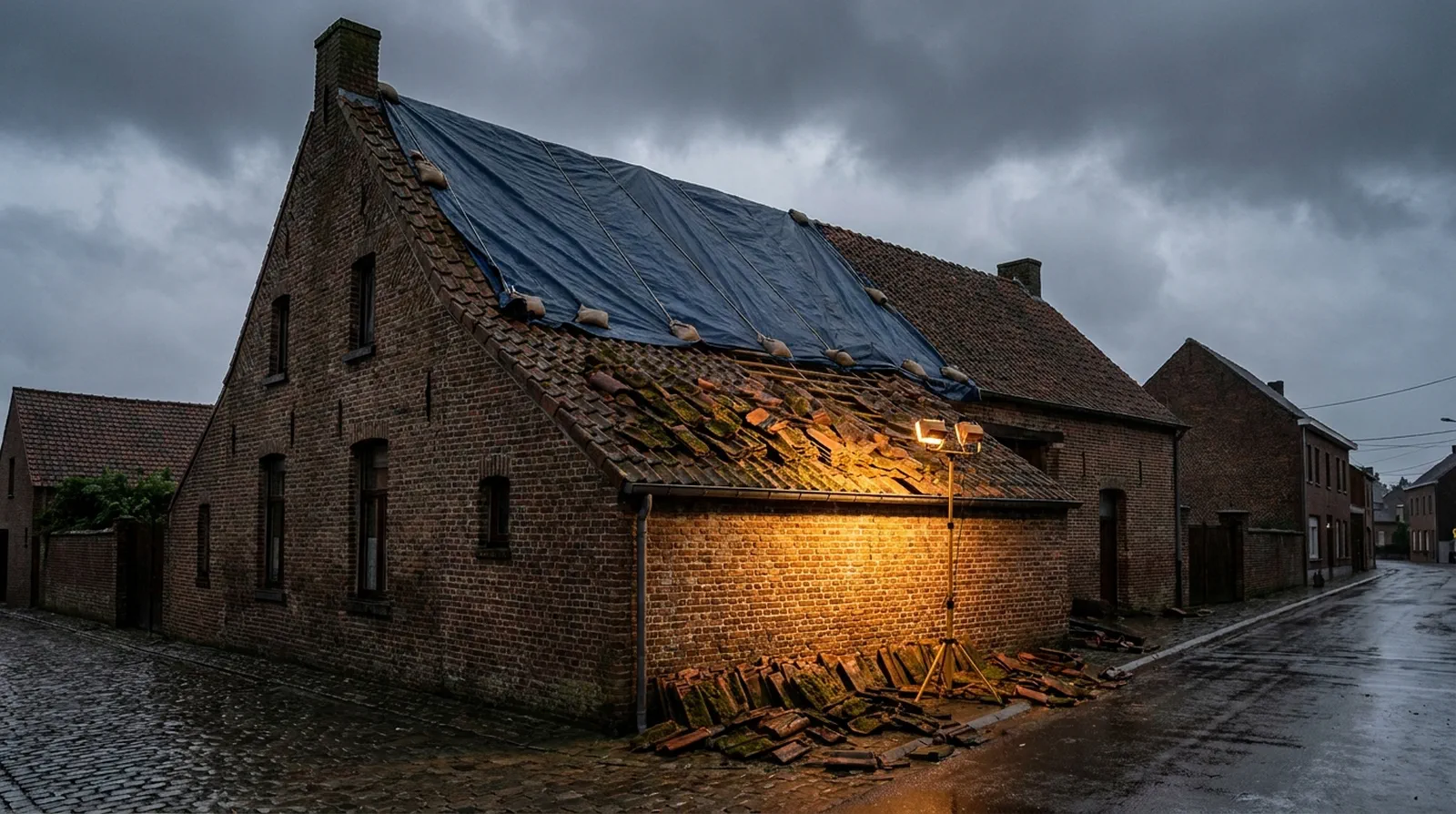
A westerly storm does not lift the tiles from above: it drives air under the slope and pushes them off from underneath. That is why the damage almost always starts at the verge, at the ridge or around a roof window — and not in the middle of the slope, where you would expect it.
What you do first
Stay on the ground. Most accidents after a storm do not happen during it, but the day after, on a wet roof with loosened tiles. Look at the roof from the ground or from a window opposite, and use the zoom on your phone.
Indoors, put a bucket under the leak and move whatever can be moved. If the water is running along a light fitting, switch that circuit off at the consumer unit.
Then call. Making a roof watertight is not a repair: it is a tarpaulin, properly fastened down, that keeps the building dry until the permanent work can start. A tarpaulin simply weighted down with stones works loose in the next gust and makes the damage worse.
The photos are your claim
Photograph before you touch anything at all: the roof from the street, the tiles on the ground, the inside with the water damage, and the date visible where possible. Your insurer will ask for these images, and a set taken before any repair carries more weight than any description after the event.
We photograph on arrival as a matter of course, even without being asked, and we hand the set over to you. If you submit the claim yourself, you then have everything to hand. In most home insurance policies storm damage falls under the ordinary fire insurance, but the conditions vary: read your policy again or ask your broker before ordering anything.
Why the whole slope has to be checked
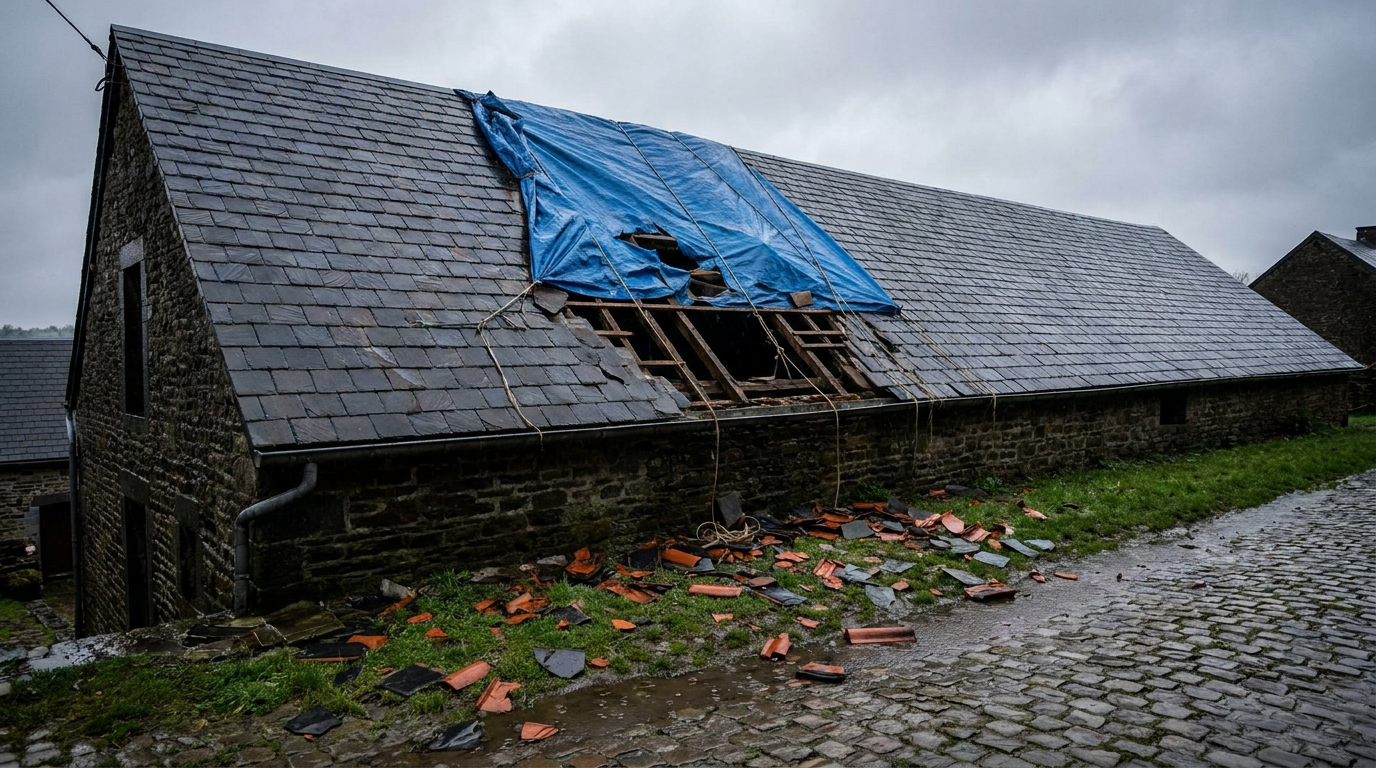
The hole you can see is rarely the whole of the damage. The same gust that took a tile away pulled on the fixings all along the ridge and the verge. Those ridge tiles stay loose without it being noticeable from below — until the next storm.
That is why, after an emergency call-out, we always go over the whole slope, including the side that looks untouched, and we check the roofing underlay. A torn underlay lets the rain run straight onto the insulation, and that only shows on a ceiling months later.
When we repair, we strengthen the fixings at the verge and at the ridge. In the open country around Asse, Meise and Landen the wind comes head-on and that reinforcement is no luxury; in town it swirls between the facades and it is mainly the roof windows and the junctions that suffer.
This service in your municipality
- roof renovation in Tienen
- roof renovation in Grimbergen
- roof renovation in Vilvoorde
- roof renovation in Zaventem
- roof renovation in Machelen
- roof renovation in Brussels
- roof renovation in Schaerbeek
- roof renovation in Anderlecht
- roof renovation in Ixelles
- roof renovation in Uccle
- roof renovation in Molenbeek-Saint-Jean
- roof renovation in Jette